A girl is carrying her mother’s seemingly externally fertilized embryos in her hands, the mushy bean pod string of portioned meat attached to the mother who led her away into a harbor. Docked to the horizon was a gargantuan ship, carrying mini-ships, tall masts supporting the orange sky receding into the sea. The orange strokes got progressively shorter as they mixed with the soapy white emission of rising tides, and segmented the sea into describable spaces all the way close to the harbor. A step ahead of the resting beast, twenty or so fishing boats speckled the horizon. Like large albatrosses arrested mid-air, their sails held breath. Further closer to the harbor was a large algal sheet floating horizontally across the horizon and transporting cranes, crows and seagulls. A barge was now approaching the harbor, decked with four-wheelers, two-wheelers and bipedal humans, standing, sitting, or scanning the horizon. As the barge docked onto the land with its metal ramp, the mother-daughter duo stepped onto it, the embryos emitting swathes of blood. They maneuvered the bean pod string away from the people stepping out of the barge, and placed it carefully on the bench next to the railings. The mother rushed to its side. A step farther away may render the string taut and snap it altogether. The daughter seemed well-versed in maneuvering.
Sweat staining your collars is something to behold. Its tangibility, the cloth sticking to your nape, is a reminder of how physiologically rooted afternoon dreams are. This time, I woke up touching my neck drenched in the salty emission. Metaphors exhausted me. They poked holes and leaked air out of my neck. I’d earlier dreamt of a baboon descending from a building (under construction) in a hoist lift and running out to stab me on my upper thigh. Making a mental note of it felt unnecessary because the pain remained palpable in its absence. Dreams had a way of dulling the sensory component and elevating real-time cognition. When you’re getting stabbed, you’re likely trying to piece together the chain of causality that led to the stabbing, which of course was not advertised as part of the tour. Dreams are educational, I guess.
The next time I sat on the barge, I turned around to see if I was either attached to or holding a trailing set of embryos shabbily packed in their bean pods. I couldn’t figure out if I was the mother or the daughter. A spectator in a dream is a precarious position to be in. Interpretations spread out both their legs, pointing in two directions. Who am I supposed to impersonate? In another dream, a fluorescent green-colored snake had slithered right up the feet of my grandparents to the tip of their skulls, and then back down through their napes and backs. They stood still in front of their house. I became an active participant in the dream when the snake started slithering at an alarming speed and pecking at me, a black dog fervently at its tail barking. This was a monstrous entity that had come to disembowel the vitality of the family by going after its members, I had thought, vitality being a joyously uninterpretable concept I had cooked up for solace. And the baboon was probably mad that I had not adhered to building regulations.
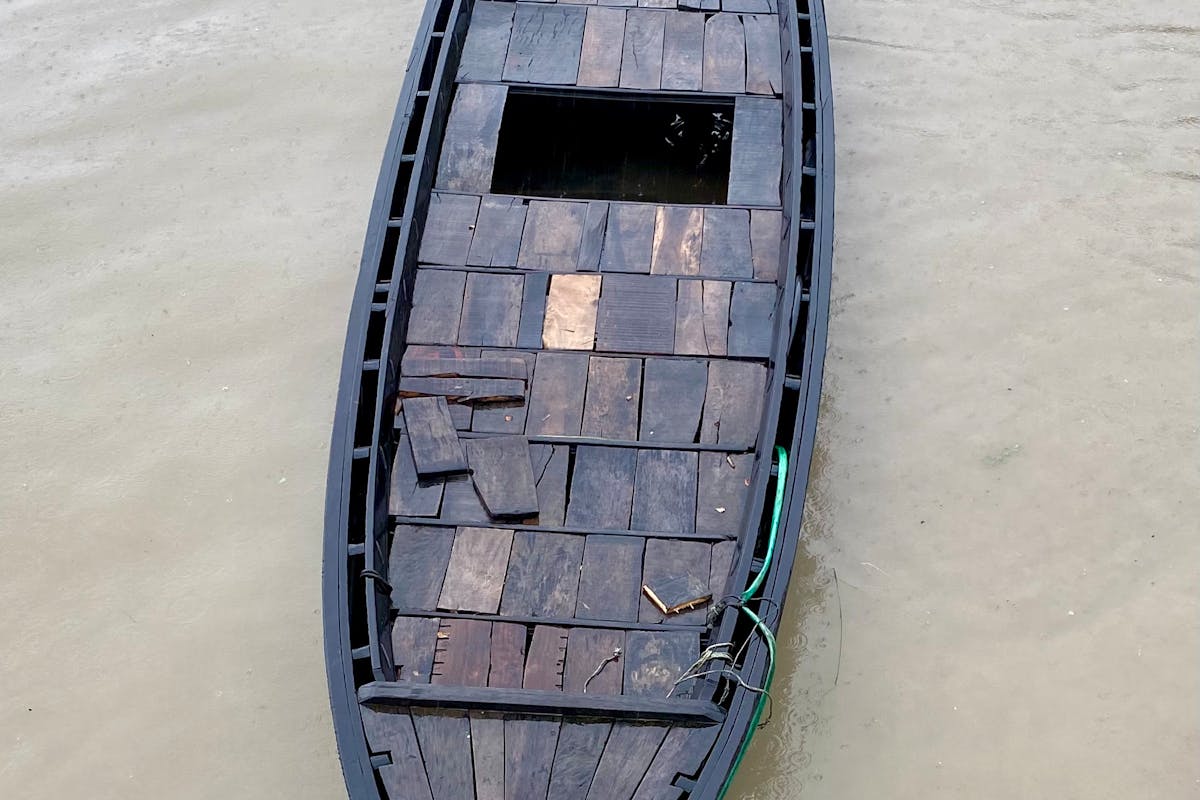
My partner and I sat close by, looking at the garbage and algae barges spotting the waters. Cranes and seagulls lined the fish nets hoisted by the harbor. The catch was poor. One fish caught in seaweed caught by the fish net. These were mostly fish that meandered from their normal streams. Trespassers and explorers. Probably had dreams of circumnavigating the world. The metal floor of our barge had tiny puddles of fish-smelling water, thick ropes coiled in perfect circles, their tails dipping in the puddles. The ride was to be for only a few minutes. Instead of circumnavigating the area by road, we had crossed over from one town to the next in no time. Displacement, as my partner called it, and I was convinced that my brain wanted to displace me, next to my mother in a fish net.
My mother was pregnant. I mostly remembered this time as a graffiti of yellow and purple evenings, and stillborn days. I couldn’t sleep next to her as the family was worried that I would hurt the baby by turning over in my sleep. These were the beginnings of differentiation. I was learning agency and how I could set off a chain of causality. I thought. I selected an action. I performed the action. I experienced the effects. I placed my finger on the burning metal face of the iron box by my own volition. I drove the cycle into a ditch by my own volition. If I wanted, I could design experiments with outcomes interpreted by the general population as negative. I ran and I stopped, and I climbed and I drove, and I wrote and I painted, and I ate, and peed and shat. A wide range of possible actions and outcomes, and learning and tuning, and fine-tuning. Yet there were bottlenecks. When you were anointed a prospective older sibling, you are more likely than not to get rewarded with an early bird registration into the adulthood circus. You are more likely than not to squeak and tweet your way into the world of long limbs and difficult eye-treks to skull tips. When the baby came, I was the first one to enter the labor room. There she was in an incubator. Apparently, the placental cord had twisted around her neck. She survived. She probably pulsated in the sac against feticidal forces on her own mother’s turf. If babies had language, we’d probably have a better idea of what it meant to meet the familiar as an existential threat, the story of adult lives.
The baby though had just made it out of the middle. She had hair on her forehead, softer than wool. Eyes were slowly adjusting to post-amniotic sac conditions, and limbs were only learning to uncurl. A screech resounded in the air, the kind that lacerates the air in the room. I wondered whether this evocation of laceration would be something she resonated with, given the condition of her previous residence. Milk skin-thin sacs ripping in places. My uncle bought me some sweets to distribute to the attending nurses. As I re-entered the birthing room, I saw my sister again. Learning, I thought. Behind a hospital-blue drape was my mother, sedated. The second time I saw her sedated was after she had her uterus removed; she was trying to shape the sound of my name with her mouth. Two sedations. Birthing and a hysterectomy. The gynecologist called us in, and assured us that the procedure was successful. She showed us, unceremoniously, the disconnected uterus. I would have appreciated trigger warnings. Later, I thought it was all appropriate.
The barge was nearing the shore. I checked my watch. Four minutes. That was fast. I looked at my partner. He was trying to fit a distant lighthouse within the rectangular frame of his phone. I probably had a minute to complete the thought train. When we get to the other side, we had planned to go to a gallery, attached to a café. If the café was expensive, we’d say hi to the curators, scan the gallery, click a selfie, and feed a goat grazing outside, while marveling at the razor blades it had for horns. But I have to pull the chain. I can’t carry this bean pod over to the other side.
One night, many years back, our mother was stranded in the city late into the night. Rain and thunder. No electricity. My sister and I were home. There was an open courtyard in the middle of the house, and rain was trickling in through the partially closed roof. Thunderbolts, flashing in through this godforsaken cavity illuminated our pale faces. We heard things thudding into our house through the window. Stray cats that my sister fed regularly. I asked them to huddle together. In order. My sister, and the five cats behind her. I strapped a part of my sister’s garment onto my waist, and the cats held onto one another’s butts. A bean pod of rescuable kids waiting to be rescued.
The barge docked onto the harbor. One more time I say partner in my head, this whole charade will self-combust into a loop of the familiar vice, I thought.
He held me by my shoulders from behind. We got down as a train. I looked back and spotted the coiled ropes, and recoiled. No. Resist the metaphor. Think. Select. Act. I am starving, I turned to him. We should start with fish.
To read poems/articles by the same author, click here
About the Author
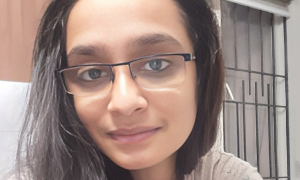
Kalyani Bindu is a postdoctoral research fellow at NIMHANS, India. She works at the intersection of genetics, neuroscience, and systems biology. Two Moviegoers was her first poetry collection. Her poems and essays have appeared in Fauxmoir, 45th Parallel, Indian Express, New Asian Writing, Guftugu, and elsewhere. She served as a poetry editor at Variant Literature Journal. As a columnist for White Crow Art Daily, she penned articles exploring various socio-cultural themes.