The Theatre of Portraiture : A Review
By Debasish Lahiri
Hieronymus Bosch, the late-medieval Dutch painter, was a pioneer in using his own face as a fingerstall. Between thimble and thumb of paint, he birthed the weft of biblical lore that ran across the warp of his personal life. No face was too alien, no feature too familiar. The search for a dramatis personae of life always begins from the confines of one’s room, and the mirror that hangs in it.
In If You Can Slip Out of Your Face noted thespian and theatre director Vinay Sharma perfects Bosch’s technique in poetry. Theatre happens around his lines. Imagination coaxed by the fingerpicks of words provides the props of visual furniture. Sharma’s poetry plucks or presses words with a deft precision that can yield various effects: from reflective to the raving, from quietude to disquiet. Often, in the course of a single poem:
if you love songs of love
…
if you love the softness in certain oft-said words
…
if you love the nature of love in animal eyes
…
if you love the sound of e t e r n a l l y
…
if you love the ways of whether
…
if you love the love of songs that love
(“disarmament” 15-17)
Sharma’s poetry draws you back into the seed, of words. The sensitive plant that is poetry grows from seeded words. With much that masquerades as poetry, using words like a pocket full of loose change rattling about, to be emptied carelessly into various slots — mechanical and newfangled, or old-fashioned, puckered and pecunious – Sharma’s lines are testament that all it takes to sound a life gone awry is to find a word out-of-place. Giving utterance to the unhouseled word is also poetry.
if
is a good beginning
it assumes nothing
…
if only
us sadder
…
what if
is hesitant
…
if if only and what if are friends or could be
if they could only ask what if we were friends?
(“conjunctions” 18)
In If You Can Slip Out of Your Face we are told that
not everything should be spoken of
yet conversations will happen
especially when alone
(“not everything can be spoken of” 33)
The fuse of the monologue that drives all dialogue recurs in poem after poem in Vinay Sharma’s collection. In fact, all that is ‘good’ in poetry (and theatre) stems from that deep-delved ‘occasion for speaking’. That’s the spur. And then the timpani of existential lack, or pain, that widens out into the symphony of an existence that thrives, despite of everything. Sharma reminds us
how word-thoughts can be refracting surfaces
making of your life everything but itself
making of the moment nothing else
(“not everything can be spoken of” 33)
When Guiseppe Arcimboldo, the 16th century Mannerist painter, began using cleverly arranged items like fruits, vegetables, fish and books to paint the human face, he was treated with the amusement accorded to skilful oddity by his patrons. Not unlike Hieronymus Bosch, however, Arcimboldo was a pioneer. He brought about a silent coup which was the philosophical parallel to the ‘decentering’ of Man in the Early Modern world of ideas in Europe. Arcimboldo paired still-life with portraiture to bring about a style that became a distant, but clear, forerunner to Cubism in the 20th century. — When Vinay Sharma writes about love, loneliness, beginnings and endings he demonstrates a grip of the ‘still-life’ of memory that creates its incantatory ambient sound around all that we get through in a day. He is also aware that by merely changing the light, its focus, the unremarkable background can magically reveal a single figure, a single face, that was always there.
his hands move still as then
his feet are the same as are his eyes
but in the portrait of his name
he finds now
the face of untold deflections
(“auteur” 37)
It is indeed difficult to slip out of such a face.
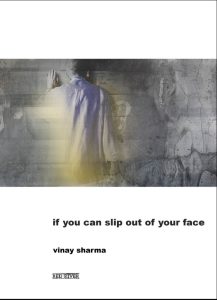
About the book: If you can slip out of your face – by Vinay Sharma, New Delhi: Red River,
INR 349 / USD 9.99, ISBN 978-93-92494-36-9
About the Reviewer
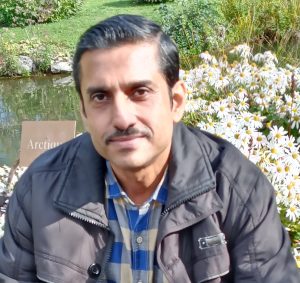
Debasish Lahiri has nine collections of poetry to his credit, the latest being A Certain Penance of Light (2025). Lahiri is the recipient of the Prix-du Merite, Naji Naaman Literary Prize 2019.