Book Review
An Insight Into The Fragile Beauty of Life
By Prasenjit Chowdhury
In a famous letter, Arthur Rimbaud wrote to the poet and publisher Paul Demeny what would become a sort of personal manifesto and creative credo for the remainder of his short, poetically catalytic life: “The Poet makes himself a seer by a long, gigantic and rational derangement of all the senses. All forms of love, suffering, and madness. He searches himself. He exhausts all poisons in himself and keeps only their quintessences”. A reading of the latest collection of poems by the poet-novelist, C.P. Surendran is akin to encountering a mimetic representation of reality, as his lines – chiselled, anguished, precise and immensely forceful – betray “all the senses”. His is a language simultaneously urban and highbrow, seamlessly switching from art analysis to little shops in Khan Market. Deeply rooted in a world of evanescent beauty and ephemerality of vanishing sunsets, he produces snapshots of a life that is so specific it becomes universal.
C.P.’s new collection blazes with wit and fury that strikes one as calm and tranquil on the surface. His dramatic talent for ventriloquism makes the reader search for the provenance of a voice. All the different voices ask where one thing does begin and another does end. His poem ‘Parents of a Disappearing Persons’ juxtaposes blood with snow, red with sparkling white, that makes many wonder how a tranquil Kashmir cohabits with violence.
The chinar draws blood through the season’s chill.
Those who shoot and those who seek must wonder.
Sitting down to a meal or raising their hands in prayer,
What keeps the snow white falling on the distant hill.
The voices seem wary of mob justice, the juggernaut of the collective mass, atomised yet serrated, lonely in the cacophony of noises. As in the poem ‘Animal Cries’ he writes:
He remembers the days, weeks, months of the year 2018
When the justice gang was hacking down the door with cellaxes.
It was in a room in a small town he slept, a turf of nylon grass
To the side of the floor, where ants played soccer with an insect’s head…
And that morning, half out of sleep on the couch shaped like a boat
He heard the boots and stilettos clomp up the steps; knew they had come to parade
Him naked again on the road. He heard cries—a dog beaten with a pipe of lead?
And then lay awoke to the rain, to the howls risen deep from his own throat.
The voices speak with varying degrees of broken and elided syntax, and take recourse to repetition, trailing slippages of time, colour and space. The ‘I’ for example is not essentially the voice of the poet, as the interminable wait for Queen Victoria at Victoria Terminus (‘Built in honor of Queen Victoria. She never turned up to visit’) in the poem ‘Arrival, Victoria Terminus, Bombay’:
The terminus awaits the queen with each train, yet.
Across the road, the old post box, accusatory, as if I owed a debt.
I think of the letter you said you posted, long after we fought.
Twenty years late, expectant, I arrive on the hour at the spot.
Sometimes the voice seems to come from the core of an angry earth that makes it subliminal as in the poem ‘What Was’:
Below the years, behind your eyes, at the bottom of the clock
A whole hill ticks away in a rose. We see it, but cannot feel
Its razor breath in our face. The evening sows gold,
Reaps coal. They burn our names, we travel slowly into rock.
C.P.’s poetry is fed with a languid sadness and a kind of irredeemable despondency. His metaphors are economical, allusions rich. ‘Dolomedes Tenebrosus’ becomes a metaphor for male self-destruction and alludes to a system where females subsequently cannibalize males, and this cannibalism leads to higher fitness for both partners. Such evolutionary distortions or Darwinism gets another treatment in the poem ‘George’, that starts with epigraph ‘and our little life is surrounded by a sleep” a line by Prospero in Shakespeare’s The Tempest, which is about the extinction of a lonely snail. Achatinella apexfulva; he was the last of his species, and died in captivity on January 1, as ‘they’ couldn’t ever get him a mate.
What’s a snail’s fury, asked Thom Gunn.
It’s the little man at war with the tyranny of his limitations
And, beaten, crawling back to the sun.
The book has as many as six dedications. The most notable one is to the poet Ranjit Hoskote titled “Self-Portrait with a Bandaged Ear.” It was in Arles that van Gogh read Pierre Loti’s novel Madame Chrysanthème (best known today as the literary source for Puccini’s opera Madame Butterfly) in which the description of Buddhist priests inspired his own Self-Portrait (dedicated to Paul Gauguin), a painting that draws out the direction he hoped the two artists would follow. The metaphor of Icarus, dying for flying too close to the sun has inspired many artists and writers, comes off as a searing, tragic fate that has befallen the human fate:
Half the sea in which Icarus drowned. The other half, singular to each,
Is where you trawl, captain of a battered ship passing from wreck to wreck,
Hauling in drowned, heroic light, and sailing close to the wind
Straining, alone and beaten, toward the Old Masters waiting on the beach.
C.P.’s description of cities and their inconsequentialities reminds one of Invisible Cities by Italo Calvino where Calvino imagines young Marco Polo, sitting in Kublai Khan’s garden at sunset diverting the aged emperor from his obsession with the impending end of his empire with tales of countless cities past, present, and future. One may sample these lines from the poem ‘Luminous’:
“We forfeited
At assigned gatherings and waiting halls,
Arrivals and departures
Where the spirit balked
And braced without hope.
And we walk the back alleys
Of this accidental town,
Past darkened doorways
And between cold cars
And empty little restaurants
Or these lines from his poem ‘Retro’:
It’s almost the same city; just that everybody’s
A little slow, fat. The morning rain’s thin
As your hair. The mirrors drive the cab in reverse,
All objects farther than they appear
Or in the poem ‘I am Nearly Not Here’
A memory of yesterday troubles a remembered prayer
Persistent like smoke from an eternally dying fire. Soul, soul,
Why do you persecute me? The Road to Damascus
Disperses lines in France’s sea of wines.
Coursing through the cities and towns in C.P.’s poems is travelling from nowhere to nowhere. Moving through landscapes that once meant something are reduced to spaces of transit where everything is temporary and everyone is just passing through, but there banalities gain a universal gloss. How personal demons such as the sense of shame at a young age that comes out of a deep humiliation in fear of its being public knowledge haunts one, is on display at the close of the poem ‘A Shortage of Words’ . Indignities can be tolerated but not the shame if the world where one puts up a brave face comes to know cannot:
I think now
Each blow to the body is a word
Deleted from the dictionary
That’s why
We don’t have more words than we deserve
The ninety-odd poems in the anthology perhaps contain a lifetime’s work, with stark epiphanies gleaned from life and soaked in blood. ‘Howl’ talks of mob justice (“When the justice gang was hacking down the door with cellaxes”), the faceless mob of “average” men and women, conformist and righteous, Daniels sitting in judgement, as in the brilliant poem ‘Charlie’s People’ in a striking aabbccdd rhyme scheme:
Which neutered cat got their tongue? Be they all saints, you might ask
In awe. Let’s just say, they are gentlemen rising historically to the corrective task.
It’s not C.P’s job to soothe. It is the cosmic pain of living and fear of death, along with “the profound sense of loss”. As Ranjit Hoskote recalled in his introduction to the previous collection of C.P. ‘s poems (Available Light) quoting him: “It does seem to me that the first half of my poetry is a way to come to terms with the shock of one’s birth. The second seems to be an attempt at fleeing death. In between somewhere there is the social world to deal with.” Poets, sensitive souls as they are, have struggled with the chaotic, difficult part of their psyche, and some of their writing has been about their personal demons. In a note of tribute to Vijay Nambisan (1963-2017), C.P. recalled: “To create, he had to destroy. And his own body seemed the closest at hand. At the centre of every poem, it seems to me, a bit of him lay bleeding ink.” One can recall John Berryman, Randall Jarrell, Anne Sexton — some American writers of an earlier generation – who coped variously with depression, alcohol or drug dependency, deep-rooted self-destructive urges. C.P. is willing to feel the emotions that come from facing the world, and his particular truths about it, unflinchingly. C.P. does not craft gorgeously cadenced lines, fresh, surprising metaphors or take recourse to sonorous combinations of words, and multi-layered allusions just to impress – but his spare lines dive down into the scary, murky depths. He is a minimalist craftsman, an aesthete dabbling in the “fragile beauty of life”.
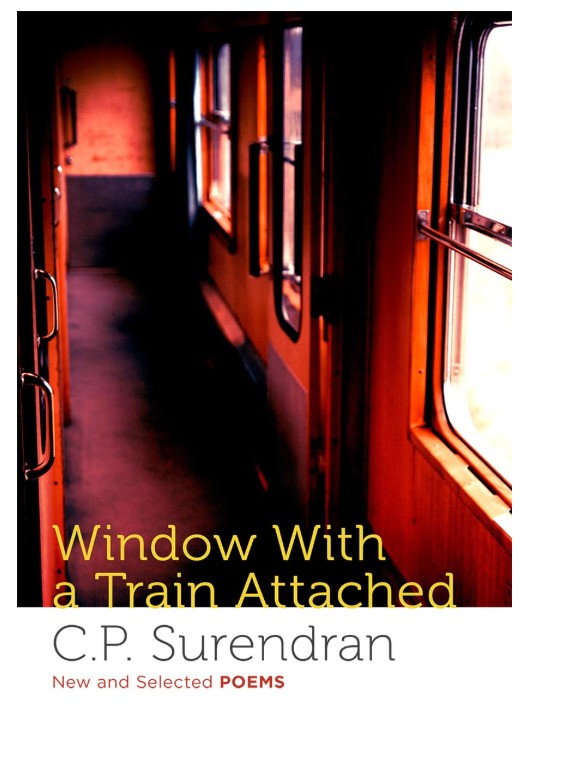
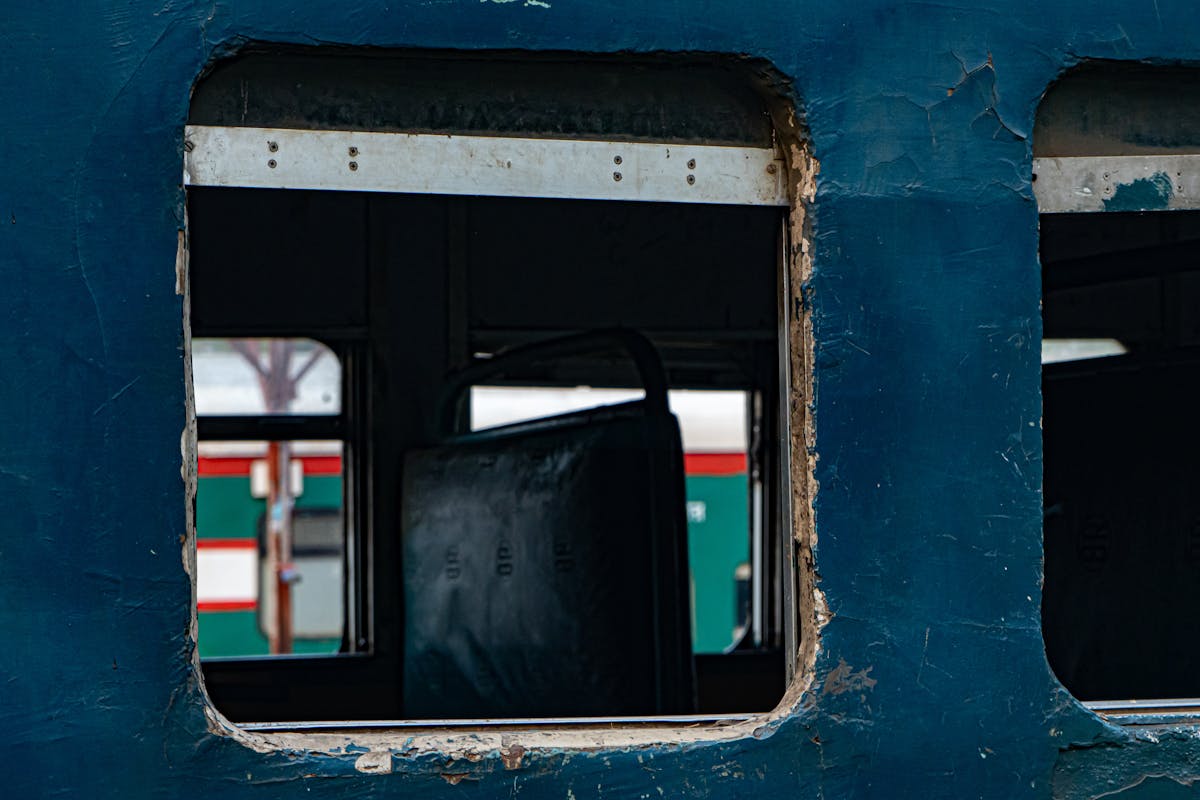
Details about the book: Window With a Train Attached: New and Selected Poems
By: C.P. Surendran / Published by: Speaking Tiger / Year: 2025 / Pp: 148 / Price: Rs 499
About the Author
C. P. Surendran is an Indian poet, novelist, journalist, columnist and screenplay writer. He writes in English and is based out of New Delhi. Surendran’s poems have been internationally anthologized, and he has received recognition for writing and journalism including Reuters International Fellowship at Oxford, Wolfson Press Fellowship at Cambridge and British Council Literature Fellowship at Cambridge.
About the Reviewer
Prasenjit Chowdhury is an independent writer for over thirty years now based in Kolkata. He has been published in the edit/oped/opinion pages of the Hindustan Times, Times of India, DNA, Asian Age, The Hindu and The Telegraph, extensively in the Deccan Herald and The Statesman – mainly post-editorial comments big and small, besides literary pieces.