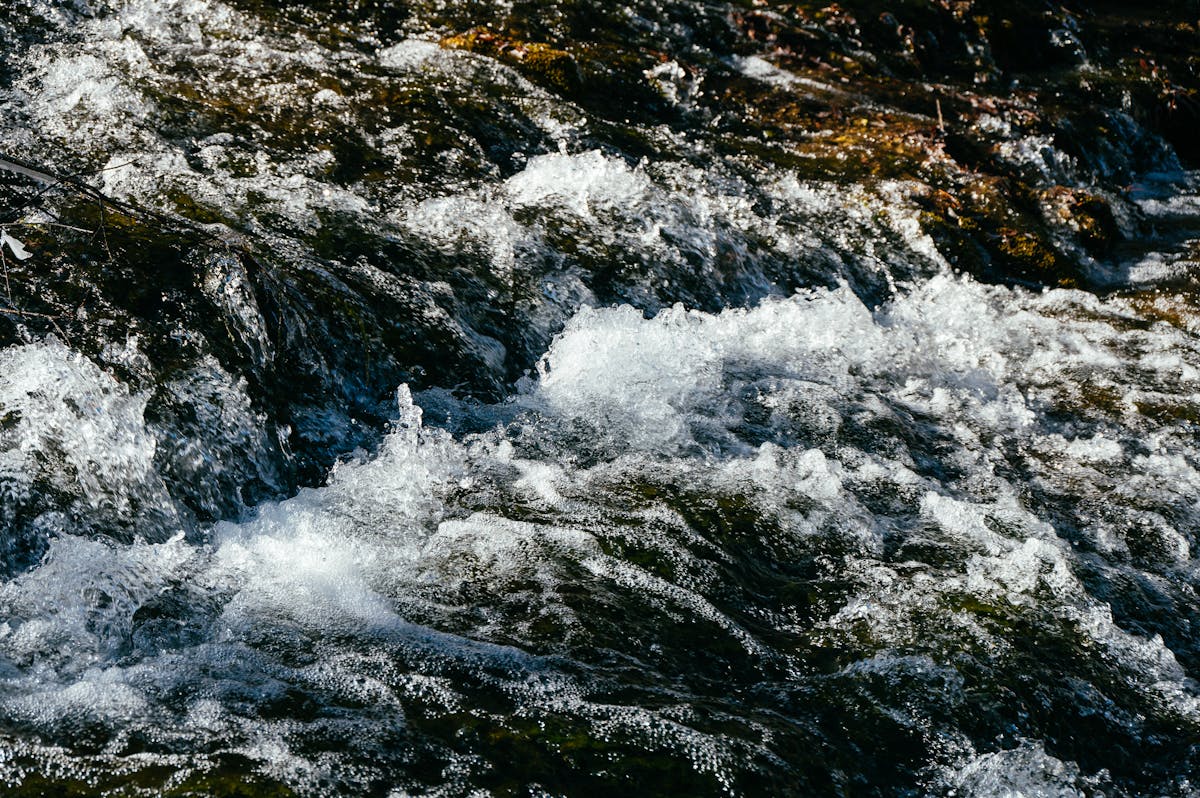
It is the element essential to life, of course. The air we breathe sustains animal life, including our own. Air emanates from water. As for the element of earth, we have developed as creatures on land, so we need earth. Fire came later, stolen from the gods, according to Classical myth. But water is fundamental. It came first. ‘The spirit of God moved on the face of the waters.’ So says Genesis. Think of the spirit of life.
I am stating the obvious. Sometimes the obvious can be taken for granted until we think about it. Thinking about water is thinking about the fundamental of life, that precious gift we squander. We waste life as we waste water. We also are capable of celebrating both water and the life, our life that rises from it.
The waters of my childhood flow through the channels of my unconscious. I know that to be so because the waters rise into my creative processes. On the surface of life I do not reflect too much on childhood. The area I left a long time ago, and have seen little of it for years. We develop in life. Yet I cannot deny what my pen finds itself writing. There are many other things of course floating to the surface when the occasion demands that I gather memories to make sense of them.
Currently I am contributing to a project on the general subject of water. The idea of this as a literary project appealed to me. The problem was that I had very little writing available. I had just published a collection with water as a major theme. I have written so much about the sea and rivers and floods that I feared it was in danger of becoming repetitive and obsessive. I deplore obsession. And so I searched elsewhere for themes of interest to me.
There was one short poem of mine available. It was about Cley-next-the-Sea, the delightful village on the Norfolk coast where we spend as much time as possible. Cley has many old houses in the Dutch style because once it was a major port conducting a thriving trade with the Netherlands.
There is also a windmill, one of the familiar emblems of the East Anglian coast and countryside. The sails are intact but unused. Today it is well known as a wedding venue. Many Cley houses are now holiday rentals rather than homes. The streets are quite ghostly in winter. Cley is no longer next the sea. The water has receded, leaving salt marsh. In recent years channels have been cut in order to bring fishing boats in. There has been some revival of an almost vanished community. There are permanent residents further inland. On the coast itself there are seals whose haunting cries drift over the salt marsh. Geese in season are much in evidence.
Stones from the shingle beach at Cley are with me now. They are in shades of blue or grey. So, too, the shell on the shelf with them. I touch them to connect mw now to the coast. To reach the sea you must walk a mile or so through the reed beds that in strong sunlight display a range of unexpected colours shimmering. When it is dull the scene is colourless. The sky is vast above the expanse of salt marsh. Rain sweeps across, dark clouds visible from miles away. There is just enough time to hurry back to the village before the downpour.
The sea has been known to rise high enough to reclaim, if only temporarily, the reed beds in the salt marsh. The sea comes and goes of course. There is a fascination about tides. The rhythm is compelling.to watch, as if one cannot quite believe that it will stop, or at ebb tide that it will ever return.
It will return and slowly erode the land in its reach. Rocks become pebbles. In time they will become the silt that enables the land to reclaim itself from the swell of ocean. We walk through the salt marsh to the pebbled shore, considering the water not as a symbol of eternity but of infinite transformation. The change is perceptible only when a cliff finally crashes. The rest of the time nobody notices how things really are.
Not only houses fall into the sea; entire towns have been submerged. Nothing remains but a name somewhere in the mud. Local legends are of church bells continuing to ring in towers beneath the waves. These disturbing thoughts are not dismissed so easily by imaginative minds.
A more rationally imaginative response was my poem about Cley. No more than a few lines, a sketch in the margins. Perhaps I could say more. I am saying it now. This is the poem I wrote:
CLEY-NEXT-THE-SEA
A long strand of stones
saltwater washed.
The wind among the reeds
carries many desires
from sea to sky, featherlight.
Ghost music drifting through
new channels and ancient ways
of water, land and waterland.
The sea shall swallow the stones.
It is only a matter of time.
When I was very young I once saw geese pass near my window. They were quite slow and sedate. Rarely do they approach houses as closely as on that late winter morning, so I was fortunate indeed. There were always gulls of course especially in winter. They sought shelter, although there was little shelter to be found.
The area was a flood plain stretching for miles with barely a hill. The farmland flooded every winter, with vast temporary lakes. Even part of the small town flooded. I have seen a river overflow into the street, but usually the water was on low lying land that was left undeveloped. It was necessary drainage for the underground streams. One could hear them. A causeway was built to connect the two sides of the town. It prevented a long detour as the only way to go.
It was a port some distance inland but none the less a port with ocean-going vessels bringing grain to the silos. The family business was conducted from a house in something of the Dutch merchant style, overlooking the quay. It had a strange atmosphere, I thought, and I was not alone in so thinking. But that is by the way.
The main river flowed to an estuary. There were several tributaries diving the area. Sadly there were few bridges so that villagers often lived close to people they never knew.
But as surely as rivers can divide communities they can make possible the connections. Where there is sea there is migration. In search of refuge or work or love they sailed into port and remained, marrying farmers’ daughters. They were my ancestors. I try to imagine the voyages, the passage slowly through, guided by the light towers. The voyage ends in a settled life disturbed only by the flooding of the land.
The tradition of the cargo boats are fewer now. The shipyard building fishing vessels and ferry boats is no more. The silos are fewer now I used to watch at high tide the treacherously fast current. There was no hope of surviving should anyone chance to fall in. An aunt had a house by the river, its garden unfenced at the water’s edge. Of course we could not go too far down.
The temptation of water is dangerous. Remembering the words of Heraclitus, there is no constancy where water is concerned. Even when it is still. What seems harmless on the surface may be treacherously deep with fast flowing undercurrents. ‘Everything flow.’ As in water so in life.
I had a dream of a village whose streets were rivers when the sea came in at high tide. When the sea receded they were streets again. There doesn’t seem to be any such place in the world. But that was my dream, its origins perhaps in my childhood.
The source of who we are is to be found in the nearest spring. There is so much literature emanating from water, beginning with Genesis and the narrative of the Flood. This is common to other cultures, notably recorded in the Epic of Gilgamesh. Either an actual history is being remembered, or the apprehension lies deep within the human psyche. What is it about water that impels the collective unconscious?
The sea is notorious for its strange events. Ghost ships are a striking example of this strangeness. There are well-attested accounts of such ships, their condition mysterious. The plague is one reason, but other ships were found completely abandoned, ships that wandered the oceans for decades. Sometimes they were regarded as an omen of disaster.
During the lockdown days of the covid pandemic there was nowhere to go but in the mind. I wrote a story of the sea I could not visit. The coastal village was imaginary, a combination of various places. I had written several times of Promise Strand. A Cold Day in May depicted dreams of wild horses running from the flood waters. It was about fear written in a time of fear, a time of the wild ravages of plague. My mind was coping with that fear.
When lockdown lifted we made a tentative journey to the coast. It was strange to travel again, released from our necessary captivity. The sea itself had receded over the years, leaving inland the remnants of the harbour. The salt marshes were a neutral zone between land and sea, a haunt of geese and other birds. A haunt of dogs unleashed by solitary walkers.
There was a warning sign that the area was subject to flooding. At any time the sea might return suddenly and powerfully. We were advised to bear this in mind. There were no wild horses but there were distant lights, as in my story. And there was the threat of flood. We looked on the Lifeboat Inn as an ark built to withstand the incoming water.
Another myth of the sea concerns me at this point. In Breughel’s Icarus the sight of the winged hero falling into the sea (and thus drowning) arouses no interest in the shepherds on the hill nor in the sailors on the boat. The incident does not concern them. They have lives to lead, with urgent demands on their time. That Icarus has escaped from the labyrinth is where myth collides with reality.
The Breughel picture greeted me as I hurried for a train. It was advertising a new novel by Michael Frayn, Headlong. I noted the title, then I bought a copy for a holiday on Crete. At very short notice our flight was re-scheduled for the airport at Heraklion, some distance away from where we were staying on the island. We had planned to visit Heraklion, however, to see the ruins of Knossos (the site of the labyrinth of the Minotaur). Our plane flew down over the very harbour where Icarus had fallen. We found a hotel for a couple of night. It was the Dedalos. There was a fine sculpture of the unfortunate hero above the entrance. Myth was shadowing reality as clouds are reflected in water. Coincidence, a powerful undercurrent of my life, is the confluence of streams, each with its own origin.
At Heraklion harbour we ate lunch. Red mullet swam down there in the clear water, innocently unaware of their fate. They were as golden as one imagines a mermaid’s hair to be. It is possible to appreciate their beauty, and also to appreciate their taste. Our instinct is for survival, as it is for the fish in the sea and the birds in the air. Every living creature competes to sustain itself. We are no different in that respect.
Consider The Fish by Elizabeth Bishop:
I caught a tremendous fish…
He didn’t fight.
He didn’t fight at all…
I looked into his eyes
which were far larger than mine…
And I let the fish go
The poem describes in detail the catching of the fish, with a fine description of the fish itself. It is a sensitive record, alert to the beauty and life of the creature caught. The poet within the hunter overcomes the instinct to catch and kill. Human survival is sustained not only by our animal needs. Intellect and empathy play their part. Respect for the fish is at the heart of Elizabeth Bishop’s poetic impulse.
Respect for the fish is the leitmotif of the poem. Respect for fish should be at the heart of our concerns. The greater part of earth is water. Land creatures like ourselves might not be the primary interest of a visitor from another galaxy. Fish lived on earth before the first hominids.
When the first creatures moved from water to land they may not have noticed any great difference. The contrast we now find was less marked in the primeval swamp. It was a life in both worlds. In their innocence those first creatures may have considered they had found paradise. There was nourishment from land and from sea. The distinction surely became clearer as life evolved to meet the demands of life in the new environment.
It is considered possible that the first word ever uttered was to do with water. My source for this is the linguist Jorgen Alexander Knudtzon The thought is speculative of course. But Knudtzon gave informed reasons based on research into ancient languages and their relation to modern speech. Given the ubiquity of water and its necessity in sustaining life, there are common sense grounds for affirming the hypothesis as a clear possibility, as clear as water it is tempting to say.
“This music crept by me upon the waters.” Among the sounds of the sea is the natural music, rhythmic and lyrical. There is music in the land, in forests of course, but also in open country. There is the tempo of the tide on the shore. But there is other music the ear within our spirit hears.
“What songs the Syrens sang is not beyond all conjecture.” So wrote Sir Thomas Browne reflecting on many things in a life he did not understand as he felt he might. To hear the songs of the Sirens was to be lured to the rocks and shipwrecked. The drowned sailors were devoured by those beautiful monsters.
Whether that myth arises from misogyny or from a careless arrogation is also a matter of conjecture. Myths can be interpreted in a number of ways. Fear and envy and other deadly vices appear in many mythic guises. We may adapt them to our desires, seeking to capture and contain the enchanting or the monstrous out there on the water. We may dream of the deeps till human voices wake us and we drown.
CLEY-NEXT-THE=SEA appeared in The Truth on the Tongue published by Cyberwit 2025
Elemental: Water, edited by Peter Carpenter, Michael McKimm and Mark Wormwald, published by Worple Press 2026
About the Author
Geoffrey Heptonstall is a widely published poet, contributing to anthologies and magazines throughout the world. He lives in Cambridge where he taught Writing for some years, and was a regular contributor to Chichester University’s Thresholds Forum. He is also a playwright with many plays and monologues broadcast, performed and/or published.