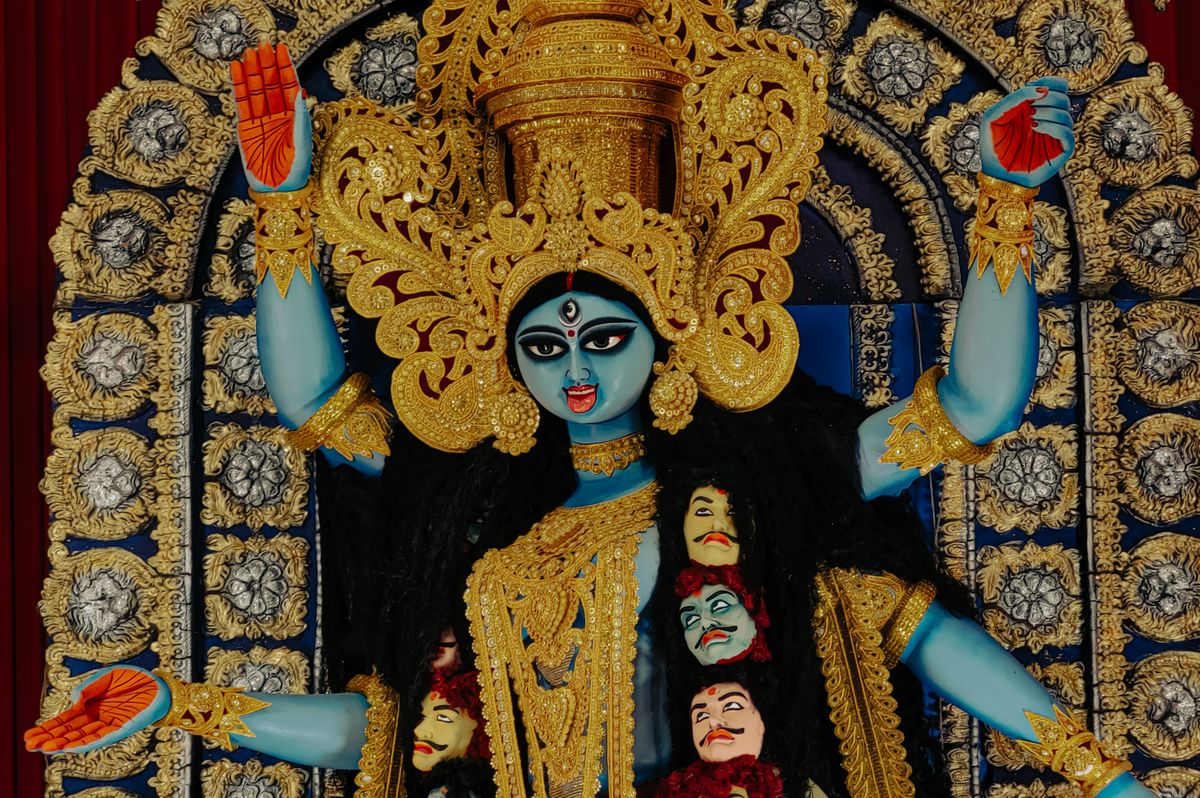
Author’s Note: These poems explore the never ending cosmic cycle originated and maintained by:
1.Yakshi (The Archetype): The physical form, the wild earth, nature, the body, and the root of all human complexity.
2.Shakti (The Principle): The living energy and the inner fire that animates that form, demanding inner transformation and surrender.
3. Kali (The Revelation): The ultimate dissolution, the mother who strips away everything to reveal that form, energy, and rage were always one single truth.
***
1. ~Yakshi — The Archetype
Her dark hair falls like ocean waves,
and the silver moon is her nose-ring.
Her eyes are stars in a dark night;
her lips — none can tell if they are dry or wet—
hide sharp fangs within.
From her sharp collarbones,
blue veins crawl upward like a wildfire.
In the middle of her chest, an island of wild beauty:
inside her, a forest breathes
with wild flowers and trees,
where spring, summer,
autumn, monsoon,
and seasons that belong to her alone
keep changing, one after the other.
Her slender fingers,
her palms and soles,
look like dry, cracked land
full of lines, marks, and hidden paths.
Her breasts rise and fall
like dark, wet marshes.
Her hips curve and bend,
held by a waist-chain tying
rivers upon rivers together.
Her navel is a deep hole
leading down to the earth’s hot core—
a box of secrets.
Below it, a perfect triangle:
a volcano waiting to wake up.
Here, the third eye opens—
awareness, the flow of energy,
power, love, truth, and pain—
the starting point of everything.
Along the dark, narrow paths of her thighs,
green meadows grow.
Two small, smooth snakes
are wrapped around her legs,
sleeping together,
and at the very tips of her toes,
bright mushrooms sprout in many colours.
***
2. ~Shakti — The Principle
If the Yakshi was the quiet forest,
Shakti is the fire
that makes it breathe.
She arrives with many faces—
storm-eyed, moon-tongued.
Her moods do not just swing;
they flood over you
like tides pulled by a hidden force.
She commands—
with stone in her spine.
She kneels—
with a river in her palms.
She is not either this or that.
She is the bridge between them.
She is the sudden crack.
She is the whole thing
that no one can ever tame.
She is the rain that feeds the field;
she is the lightning that splits the tree.
A living myth that bleeds.
A puzzle wrapped in warm skin.
Try to hold her—
with all her huge power,
her wild energy,
her love and her hunger—
and your hands will shake.
To know her is not just opening a door.
It is splitting open your own chest
with a key made of bone.
Every time you look,
you find another hidden room,
another altar,
another wound that sings.
Yes, it will hurt.
It is the kind of pain that melts your bones,
that makes you forget
the names of your own hands and feet.
You will break apart
the way continents split—
slowly at first, then all at once.
But then…
then you might learn
to touch her
the way the morning light touches a closed flower:
without demands,
without trying to conquer her,
just watching,
just breathing
with soft, human hands.
Do both.
The breaking and the blessing.
Otherwise, you leave her half-sung,
half-known—
like a journey that stopped
at the very first river.
This takes hard work, yes.
Work of the mind and blood.
Of the spine and silent prayer.
Focus like holding a candle
underwater.
Meditation like a free fall
straight into the dark mouth of a god
who is also a woman,
who is also you.
***
3. ~Kali; The Mother — The Revelation
If the Yakshi was the forest,
and Shakti the fire in its roots—
then this is what it means
to stand right in the middle of the fire.
Kali’s love hits like a giant wave—
not just water, but a reckoning.
She will not ask for your permission.
She will drag you to the dark ocean floor
of your own hidden fears,
and force you to look at the ghosts
you thought you had drowned.
She will teach your lungs
how to sing in salt.
She will break open the storm
locked behind your ribs—
yes, it will hurt—
but just watch:
the same water turns into a womb.
The same drowning turns into a birth.
She breaks you down
the way only a mother can:
to make you brand new.
Her desire is hot lava.
Not a poetic trick—
it is real heat.
It finds the cracks in your bones
and makes them melt.
Bone turns to river.
Breath turns to ash.
She leads you barefoot
to that wild country
where pleasure and pain live in the same skin,
where your deepest secrets dig themselves up
and grin at you
with your own teeth.
Her laughter is not just a sound;
it shakes the little altar
you built in your chest.
Her smile is a sharp blade
dipped in honey.
You will beg to drink her poison,
and call it sweet.
And her rage—
oh, her rage…
has no words at all.
It is the sound
the universe made
before the very first word was spoken—
a dark space with teeth.
It does not just kill you.
It completely un-makes you.
Worlds fall apart
into the deep wells of her crying.
Galaxies fold up
in the fever of her anger,
and you…
you are pulled down the throat
of your oldest demons.
This is not death.
This is the quiet moment
before the first star is born.
A lonely place
where all your maps come to an end.
And still,
if you have done both—
if you stood in the giant wave
and did not run,
if you let her hot lava
change your bones,
if you stared into the dark
and did not blink…
then you will know:
She was never three different things.
Love, desire, and rage
were always one breath,
one God,
one woman…
The exact same fire
that burned you
was the one
that kept you alive
in the dark.
About the Author
Bhoomi J N is an Asst.Professor of Philosophy at University of Calicut. Her research focusses on on gender, power dynamics and Post-Marxism. As an interdisciplinary artist, Bhoomi seamlessly weaves together performance art, movement design, and creative expression. With a unique blend of academic rigor and artistic innovation, Bhoomi’s work navigates the intersections of philosophy, gender, and performance.