1
Mother,
I told you I would gather the forest’s wood and return.
Father never said, “If your axe is weak,
come back before sunset.”
The forest, Mother—
full of dry fruit and thousands of worms,
white dead rabbits, and roaming wolves.
The village dogs were noble;
they understood the language of stones,
and if someone lost the path,
they became the guide.
Five years have passed,
and the almond wounds grow deeper with salt.
In the forest, no one fears for me
when I cross the road,
and in the morning I do not drink milk—
like a bride bathing with a pumice stone.
Night falls in the forest,
and though I sleep on feathered pillows,
my dreams do not fly.
Blood-stained chairs nailed to their fate—
where did all those ships come from,
until even the night grew tired
of our quick, exhausted dreams?
Father,
I never return without wood.
I never return.
I do not return.
So each time,
I send you a charred bone
from my own body.
2
Mother,
tear my old photographs—
the one in them is no longer me.
Five years are enough for a new birth.
Erase the numbers of all the friends who left;
five years are enough for springs to change
if no cloud passes over them.
The woman who spreads shade like a mat
and gathers the plates of the sun
told me, “You—
a song makes you sad.
You now sell flies
and forget to place bread on the pavement;
the birds starve.”
Your sadness, she said,
is quiet—
like a needle falling
on a forgotten pillow.
Mother,
first bracelet around my wrist,
last jewelry shop that stopped me—
do not open the door
to those who do not ring the bell,
who pound with hands and feet.
The laundry worker told me
the village has become very empty,
and the fields we plant
are not visited even by wicked birds.
We no longer build scarecrows,
and when the moon grows thin,
we light the house lamps.
Mother, the guests are here—
so many of them—
but the fridge is always empty,
so we do not open the door.
Mother,
tear my old photographs,
and keep a new one—
I will send it soon,
very soon,
when the first photographer
agrees to capture me for free.
3
We must paint the house again,
no matter how the nails dig
into the wall’s ribs.
We must hang new pictures—
that is how it is.
And that stopped clock—
we will change its battery,
O Time.
Why not laugh in a new color
if we paint the house green?
All the old spider homes
we will wipe away with a worn cloth,
and tell this whole calamity:
a day will come
when the postman knocks on our door again,
returning with boxes
of forgotten gifts.
Sing with me—
like any ugly lover
mad for a beautiful woman,
singing and singing,
knowing she walks with a stranger
yet never leaves his memory.
Sing with me—
like a child who named her doll
and forgot her father’s name.
Tear the musical notes,
the drums,
all the instruments—
sing,
as my mother used to sing
while sweeping the house,
cleansing the dirt
we carried from the streets of this world.
4
I knew the train would return to its station,
and that the fruit crates we carried
to distant cities
would come back only with screams
to the house where the wind
rolled up its sleeves.
But what I did not know
was that the village would remain empty
when the harvesters passed,
and that the auctioneer
would stand alone,
selling receivers
in a city without electricity.
Father,
I had to understand
the smoke of trains,
and that large villages explode
when they eat dry bread every day.
What I cannot understand
is how Mother,
while cleaning lentils from straw,
burned in her songs
every reason for sadness.
Every day, my face sticks to the window;
a white cloud approaches me
like my mother’s prayer shawl.
I never caught butterflies, Mother—
I remember flies,
and mud,
and the blanket you covered me with
when I was small.
I blow on the glass
and wait for rain.
Traveling alone—
I am sad, Mother,
even if they hand me orange juice
and free newspapers on the journey.
I cough a lot these days
and disturb the neighbors.
About the Author
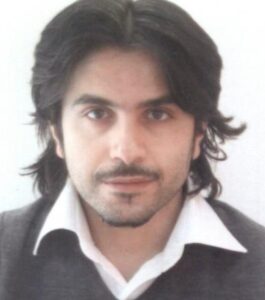
Nawzad Jaadan is a Syrian poet and writer. He was born in Damascus to a Syrian-Kurdish family living north of Aleppo, and his father is the writer Ja’adan Bakr Ja’adan. He studied media at Damascus University and graduated in 2008. He currently works as a journalist in Sharjah, United Arab Emirates. Ja’adan has written five books: three poetry collections, an anthology of short stories, and an in-depth look at the history of Bollywood in a book titled Founders of the Indian Cinema.