“Who is I?”
An Interview with Alta Ifland
by John Taylor
I have enjoyed a stimulating connection with Alta Ifland’s Voix de Glace / Voice of Ice ever since the book was first issued by Les Figues Press in 2007. The very way in which she had drafted the book struck me immediately. The Romanian author, who had a doctorate in French literature and was living and teaching in the United States, had written the prose poems and short narratives of the book in French, her second language, and then self-translated them into English, her third. I was convinced by this daring linguistic tour de force, but especially captivated by the compelling contents of the book as well as by the essential literary and philosophical questions that it raised. I reviewed Voix de Glace / Voice of Ice at length for Words Without Borders in March 2010, then republished the essay in the third volume of my Paths to Contemporary French Literature (Transaction Publishers, 2011, now available from Routledge). This essay, in a slightly expanded form, has now become the introduction for the new Punctum Books edition of this mysterious and moving collection. But this is not all. Ifland, after living some thirty years in the United States, now lives in France, as I do. Thanks to the Romanian Cultural Institute, we were able to meet and take part in the “Nuit de la Littérature” festival on May 30, 2026 in Paris, where we discussed the book in public. The interview that follows is a reworked transcription of our conversation.
—John Taylor
**
John Taylor: You are Romanian. Why did you decide to write this book in French and then self-translate it into English? The back cover mentions an “estranged self” living far from her mother language. Can you explain?
Alta Ifland: When I wrote this book, I had been living in the U.S. for 13 years in an environment half-American, half-French (I taught university-level French for about 10 years). English and French were the languages that were closer to me in a literal sense—at the time, in Northern California there were no Romanians I knew, so I only spoke Romanian when calling my family back home. But, more importantly, having left Romania in 1991, shortly after the fall of the Communist regime, at a time when one left without knowing if one would ever come back, I left everything behind: my family, my country, my friends, the few possessions I had, and my language. My not speaking and writing in Romanian was a voluntary dispossession and de-naturalization, as well as a psychological one, as I found it impossible to write in Romanian.
J.T.: There is a strange novel, Flatland, written by the theologian and Anglican priest Edwin Abbot Abbot in 1884. The author imagines a world in which all the characters have two dimensions. My father, who loved mathematics, as I do, had a copy in his personal library and gave it to me when I was a teenager. When I received a review copy of Voix de Glace / Voice of Ice, after the first edition was published in 2007, I knew nothing about you. I was immediately struck by your name, which I suspected was a pen name. I wondered if it implied that the prose poems in the book outlined a literarily “high”—one could almost say “high-brow”—land in which everything would be conjecture, hypothetical. Moreover, after reading the book, I had the impression that this was the case. But am I perhaps going much too far with my onomastic analysis?
A.I.: Everybody assumes “Alta” comes from the Spanish “high,” but this is not the case. It comes from the Latin “alter,” as in “alter ego,” which has given “alta” in Romanian (meaning “other”). On the other hand, Ifland was the maiden name of my late mother-in-law. The story of her family is fascinating: Russian Jews from Crimea who emigrated to China around 1900, then to the U.S. I wrote a novel about it called “How I Became an Ifland”—still unpublished, although it is probably my best work. But you are right that the name (if-land) implies something hypothetical. It is the very hypothesis of fiction and identity. That’s why I took it.
J.T.: This brings me to a similar question, indeed related to this issue of “the other.” Is Voix de Glace / Voice of Ice autobiographical? Or should it be read as a “fictive autobiography”? Or pure fiction? Or all of the above? There are many surrealist prose poems in the book, but then, from time to time, you seem to tease your reader with allusions to Eastern Europe, to the Balkans, thus implicitly perhaps to your native Romania. Moreover, the book begins with a text titled “Birth” and concludes with another text titled “Death,” as if an entire life had been traced out. Near the middle of the book, a text titled “I” in English and “Moi” in French concludes “Who is I?” I cannot help but think of Arthur Rimbaud’s insight “Je est un autre,” as expressed in his famous letter to Paul Demeny of 15 May 1871, and of the remark attributed to Gustave Flaubert: “Madame Bovary, c’est moi.”
A.I.: A “fictive autobiography” doesn’t sound bad! “Pure fiction,” certainly not. It isn’t an “autobiography” in the sense that I didn’t write these poems in the confessional way most American poets wrote at the time. But it is a book that, of all my writings, expresses my self in the deepest way. The poem you are referring to (“Moi”) invokes my paternal grandparents from the traditional region of Oltenia, but it is simultaneously a questioning of any kind of “I.” For how could “I” be the granddaughter of people who lived in a pre-modern kind of world, and, at the same time, a woman who lives in California’s outlandish Bay Area for whom such people look “exotic”? The autobiography is necessarily doubled by a reflection on the I who writes, because as soon as one puts something on paper, the auto-biography turns into some kind of fiction, and one’s own life appears incredible. At the same time, the book has a playful (“ludique”, as one says in French) aspect, which may give the impression of artifice. And artifice is the very opposite of a confessional mode.
J.T.: Some texts in fact evoke a “double,” even “my double’s double,” as the title of one piece formulates it. Here is how you conclude the text: “And if my double had its double too? Would its double be me then? I don’t know, but I know that I is but the doubtful and unlikely shadow of my double.”
A.I.: I was always fascinated by the theme of the double and of the twins. I think it is a universal structure. I have a novel—also unpublished—about two sisters who look almost identical, but one grows up in the U.S., the other in Romania.
J.T.: To follow up on what you are saying, let me quote a few sentences from another key text, “Mourning the country”: “One night, I decided to kill it. I mean, it, the country. I imagined a huge field of golden wheat and told myself: ‘Look at it closely, because it’s for the last time. Never again will you see it.’ I cried all night. In the morning, the country was dead, dead forever.” How are we to understand this “murder”?
A.I.: It is a poem about the symbolic murder of the country of origin. And implicitly of the native language too. Leaving my country was a symbolic murder—that’s why I was never interested in writing in Romanian (in fact, even writing the possessive “my” in “my country” feels very awkward, as if I was confessing something shameful). I mourned its loss before leaving it, and then I never missed it ever again. In all my years of exile I never missed Romania—except, well, when I thought I was dying, a few years before I left the U.S. for good. I was chronically ill and afraid I was going to die without ever going back to see my family—that’s the only time I missed the country. By the way, this is one of the poems whose ending I changed in the second edition: “What is a country? An impossible land” is a much softer ending than the one in the first edition (“A fiction for the brainless”). Between the two endings lies a gulf filled the by thirty years I spent in the U.S. and the murder of my second country.
J.T.: Another text expresses a kind of nostalgia for the “dead country.” I am referring to “The sweetness of things, in the old days,” in which you recall Sundays during which men wore suits and women flowery dresses; then you evoke a pastry shop and later how you would “touch” a girlfriend’s toys “as one touches things wrapped in a layer of honey.”
A.I.: This poem was inspired by a photo of my father holding my hand when I was less than two-years old. He was wearing a suit—he looked like an actor—and I was wearing a pretty flowery dress. We were returning from the soccer game, if you can imagine (compare this with the apocalyptic images following the soccer game in Paris the very day we had this dialogue). It was a time when people used to dress up on Sundays. We had a ritual: he would take me to the game, the soccer field being at the edge of the park; then, we would stop in the park and then, before coming home, I would get a desert. So, yes, this is a nostalgic poem, nostalgic both for the Paradise Lost of childhood, but also for a time when humans had a more peaceful, ritualized way of living. My father died in 2025, as I was preparing the second edition of this book for publication, so I am glad I immortalized a time of shared happiness for us.
J.T.: While rereading Voix de Glace / Voice of Ice for this interview, I was struck by the importance of the “eye,” not exclusively as a sign or symbol of perception, of vision, which is common in literature, but as a genuine object in itself. The very first sentence of the book is “I was born in a lapse of time, my hand clinging to a dandelion, my feet gripping a vine leaf, my nose on my back, an eye on my ankle.” The first sentence of the third text, “Voice of Ice,” which thus gives its title to the collection, similarly reads: “I speak from inside the long stem of a flower, and with each word a pearl of dew falls from the flower, which at night becomes an enormous eye brimming with tears.” This beautiful image, which also expresses a movement, makes me think of surrealist imagery in the sense that it adopts an unexpected perspective and yokes together rather heterogenous elements, such as the narrative voice inside a long stem along with words and pearls of dew. Is there a relationship between your writing and European surrealism, or perhaps with other literary movements?
A.I.: I think many East-European writers have a surrealist sensibility without necessarily having been influenced by surrealism. Besides, there are important Romanian writers who were associated with this movement (Ilarie Voronca, Tristan Tzara). But in my case, I think my influences are rather the poets who have preceded surrealism (Lautréamont, Nerval). Regarding the eye, I myself noticed its presence when I reread the book. I think there are images and themes we are sometimes haunted by and we need to write them down, to re-present them, as if to exorcise them. During the entire time I wrote and translated this book—several months—I was in a state of heightened sensitivity. I remember that the image of the eye from Bunuel’s film “Un chien andalou” also haunted me, as well as images of a dismembered body. Maybe the eye is the symbolic representation of a desire to capture something that is ineffable; or maybe it represents a desire to give visual continuity to a fragmented I.
J.T.: Of course, something much more personal than a literary movement is at stake in Voix de Glace / Voice of Ice. Let’s continue to focus on the title piece. What exactly is this “voice of ice”? The prose poem insists on this image of a voice inside the stem of a flower, and the final sentence reads: “I speak from inside the stem of an ice flower that has frozen inside my eye, and I can no longer leave my eye, can leave no longer.”
A.I.: You are forcing me to become a psychoanalyst of my own writing! Let’s see: normally, the eye has a moist surface, so an ice flower that has frozen inside it would contradict its liquidity, hurting it. By the way, the image of the tears (appearing later in this poem: “an enormous eye brimming with tears”) is also present in other poems. As a parenthesis, I should add that Californian poet Wanda Coleman, who read my book in order to write a blurb, gave a very inappropriate interpretation of the theme of the tears in this book. As a feminist, she was annoyed that “I” was crying too much. Clearly, she’s never read Emil Cioran, who wrote “of tears and saints.”
Then, there is the feeling of being stuck inside the eye—which replicates probably the general feeling I had while writing most of the poems in this collection. I felt I was suffocating. I would say that there are two opposite elements present here: ice and tears, and their contradiction is resolved esthetically in the image that carries their tension. Maybe their esthetic resolution is present in the very title—“voice of ice”: maybe in order to acquire a voice, one needs to freeze one’s tears.
About the book: Alta Ifland, Voix de Glace / Voice of Ice, with an introduction by John Taylor, published by Les Figues, an imprint of Punctum Books, 2025, 155 pp., ISBN: 978-1685713003. To order this book: https://punctumbooks.com/titles/voix-de-glace-voice-of-ice/
About the Author

Alta Ifland was born and grew up in Communist Romania. She came to the U.S. as a political refugee in 1991 and, after a PhD in French language and literature, she taught for a brief period in academia, then worked as a book reviewer, a writer in her third language (English) and a literary translator from/into Romanian, French and English. She is the author of two collections of prose poems (Voix de glace/Voice of ice, 2008 Louis Guillaume Prize, reissued in an improved edition in 2025 by Punctum Books; and The Snail’s Song) and two books of short stories (Elegy for a Fabulous World, 2010 finalist, Northern California Book Award, recently released in France in her own translation; and Death-in-a-Box, 2010 Subito Press Fiction Prize of the University of Colorado). Ifland’s novels, The Wife Who Wasn’t—a satirical comedy about Moldovans versus Californians in a post-Communist world—and Speaking to No. 4—a psychological mystery about a vanished woman that takes place in France, Japan and the United States—were published by New Europe Books in 2021 and 2022. Ifland’s latest book in English, Two Queens and a Chronicler, an atypical historical novel, was published in 2025 by Open Ends Press. After 30 years of life in the U.S., Ifland now lives in France.
About the Interviewer
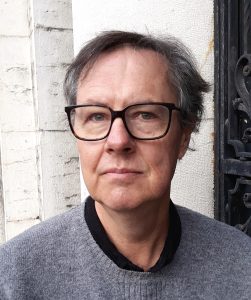
John Taylor is an American writer, critic, and translator who lives in France. Among his many translations of Italian, Modern Greek, and French poetry are books by Philippe Jaccottet, Jacques Dupin, Pierre Chappuis, Pierre-Albert Jourdan, José-Flore Tappy, Charline Lambert, Béatrice Douvre, Pierre Voélin, Georges Perros, Elias Papadimitrakopoulos, Veroniki Dalakoura, Lorenzo Calogero, Franca Mancinelli, and Alfredo de Palchi. He is the author of several volumes of short prose and poetry, most recently Grassy Stairways (The MadHat Press), Remembrance of Water & Twenty-Five Trees (The Bitter Oleander Press), A Notebook of Clouds & A Notebook of Ridges (The Fortnightly Review Press), which is a “double book” co-authored with the Swiss poet Pierre Chappuis, and What Comes from the Night (Coyote Arts Press).