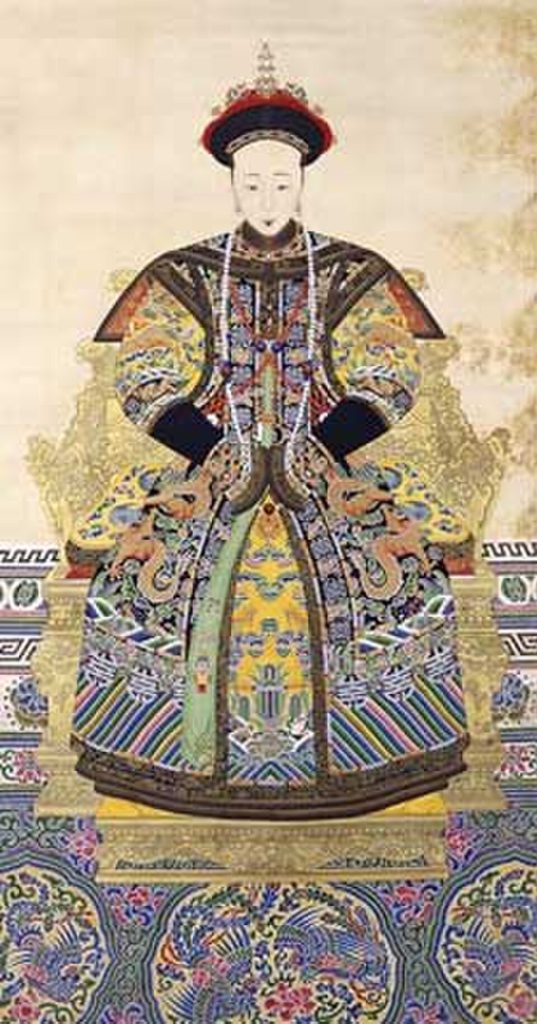
Toward the end of his life, the peasant-poet and sandal-maker Chen Hsi-wei retired to a small cottage outside Chiangling. Here he received a two-week visit by the Tang minister Fang Xuan-ling. After each of his afternoons with Hsi-wei, Fang returned to the governor’s villa in the provincial capital and spent each night recording their conversations. These mostly concerned the origins of Hsi-wei’s poems of which Fang was an admirer and collector. However, their discussions sometimes turned to politics, especially to Hsi-wei’s views of the brief but consequential Sui Dynasty and its two emperors. Hsi-wei admired the first, Emperor Wen, and despised the second. Yangdi was perhaps the worst of China’s many emperors, a ruinously poor ruler. One of their discussions turned to Yangdi’s widow, the Empress Xiao, whom he regarded as a good woman wedded to a monster. He felt both sympathy and pity for the empress who survived her husband’s fall. The poet interested himself in her extraordinary life and especially her well-known rhapsodic testament, “My Aspirations.”
As they were enjoying the fine meal Minister Fang brought, as usual, from the kitchen of the Governor of Chiangling, Hsi-wei filled his guest’s teacup and asked his guest a question.
“It’s almost eight years since the fall of Sui. After Yangi’s assassination, I understand the Empress and her ladies were taken into custody by General Yuwen Huaji. I’ve heard both that they’re still prisoners in Jiangdu and that they have gone into exile. My Lord, do you know what’s become of them?”
“You’re interested in our former empress?”
“I am.”
“That surprises me.”
“Why so?”
“Because I know your feelings about her husband.”
“In my opinion, she is not at all the same as Yangdi. In fact, I believe she did her all she could to curb his excesses and rectify his behavior.”
Fang sipped his tea. “Is that all that interests you about the empress?”
“No, there’s more. But do you know where she is, if she’s still alive?”
“Last I heard she was living in the north, beyond the Wall.”
“She was sent away? Exiled?”
“Yes and no.”
“Can you explain?”
“Three or perhaps four years ago, Emperor Gaozu received an ambassador from the Götürk Khaganate. The man brought a request from the Princess Yicheng asking that the empress be sent to her. Given the unrest at the time and the well-known influence of the princess among the Turks, it was deemed prudent to grant the request. It was a wise decision. It ensured peace on the northern frontier and resolved the problem of what to do with the empress.”
“Then she is still in the Khaganate?”
“So far as I know, yes, and probably plotting the return of the Sui with her friend. But what else interests you about the lady Xiao?”
“Do you know how she became empress?”
“Of course. Because she was married to Yang Guang, Wendi’s successor.”
“And an unworthy one. But do you know how that marriage came about?”
“Oh, for the usual reasons, I suppose. Reasons of state.”
“There’s more to the story, and more to Empress Xiao.”
“I confess I don’t know the details. Our new dynasty isn’t terribly interested in the last one. We have much to do.”
“Understandable, yet much of what the Sui accomplished has been retained by the Tang. I don’t mean just the reunification of the empire, the Grand Canal, and improvements to the Wall, but Wendi’s penal, currency, and land reforms, restoration of the examination system and promotion of Buddhism, along with his three departments and six ministries, including yours, My Lord.”
“Yes, all the work of Emperor Wen. I’ll concede that the Sui, for all their faults, did provide a sound foundation on which are building. But, again, what especially interests you about the Empress Xiao?”
Hsi-wei put aside his cup and plate, cleared his throat, and spoke at length about matters that must recently have been on his mind.
“Xiao was the third daughter of Emperor Ming of Western Liang, a minor ruler. She was born in the second month, and her father was a superstitious man. He believed that to be born in Xìngyuè was unlucky and would bring bad fortune. So, he sent the child away to be raised by an uncle, one of Liang’s minor princes. But both that prince and his wife died soon after, and the child was sent to another more distant uncle, one who was not a prince but a poor man, virtually a peasant. Here the future empress had to work both at home and in the fields. It’s said she did so without resentment, meekly. When she was grown, the civil war between Emperor Wen and General Yuchi Jiang broke out. Her father supported the emperor at a crucial moment and, as a reward, the Wendi declared that one of Ming’s daughters would marry his second son. Now, Ming had three daughters two of which were not born in an unlucky month, were bought up as princesses, not sent away and forgotten, two daughters who did not work in the fields or ever went to sleep hungry. Ming called in his fortune tellers to decide which of these two daughters should be married to the emperor’s second son. The fortune tellers rejected both, which must have been a shock to Ming who was paying them. It was then that he remembered the daughter he had sent away so many years before. He had her found, recalled, and examined by the fortune tellers who pronounced her the one. Really, it’s like a fairy tale, and yet I was assured this is how things happened.”
“Well, perhaps it’s true,” said Fang. “The empress was also described to me as meek but also intelligent and a gifted fortune teller herself.” Fang paused and raised his eyebrows. “Do you think she conspired with her father’s fortune tellers, that they knew each other as, so to say, colleagues?”
“It seems unlikely. Xiao lived far away, remember, and in obscurity. Even her father had forgotten her. To me, what’s interesting is her upbringing which included field work and, because she was literate, study as well.”
Fang chuckled and remarked, “Not unlike yourself.”
Hsi-wei nodded. “There’s something in that. Though I’m a peasant raised by fortune and Xiao a princess fortune treated badly, we both know the odes of Yin Jifu and where rice comes from.”
“I suppose so. So, you think that rough childhood is what created her resilient character?”
“Yes, and also her differences with her husband. Peasants can be crude and covetous, but they aren’t spendthrifts. Yangdi and his older brother Yang Yong were both unworthy of their father. Both were lascivious, lovers of luxury, a pair of dissipated and wasteful spoiled brats.”
“I won’t dispute the characterization, but there was a difference between them, wasn’t there?”
“And I expect the empress knew it very well.”
“That difference, would you call it cunning?”
“Cunning? Yes, though it’s a kind word for Yangdi’s scheming. As we both know, Emperor Wen loved thrift, and the Empress Dugu deplored concubinage. Yang Yong, the crown prince, violated his parents’ strictures spectacularly and impudently. Yangdi, however, who had the same impulses and an even worse character, managed to conceal both from his parents. He restrained himself sufficiently to see his brother deposed and replace him displace him as crown prince.”
“And you’re sure Xiao knew his designs?”
“I believe so. I imagine she went along with them. What else was she to do? Or perhaps she too was deceived or chose to be. But I think Xiao knew what her husband was and hoped to reform him. There’s an old saying that at the bar of marriage every groom thinks his bride will never change and every bride is sure that her groom will.”
Fang laughed at this. “Good peasant wisdom, Master Hsi-wei, but rather cynical, wouldn’t you say?”
“It’s for you to judge, My Lord. As you know, I never married.”
“So, you think Xiao set out to reform Yangdi. Are you alluding to Empress Xiao’s poem, ‘My Aspirations’? Is this also something that interests you about her, another connection, that you both write poems?”
“Yes, it’s true. I’ve read that poem of hers many times. The ‘Shu Zhi Fu’ is a kind of rhapsody following no strict form. It is most often read as a profession of Daoism, and that’s not wrong. I uphold non-action and embrace unity, she wrote. And also, knowing that unrestrained boasting is not the Way, I thus nourish my life in calm serenity. These lines show by how much the empress differed from her husband. She must have suffered to see his extravagance, the waste, the backbiting and opulence of court life. It’s all in her poem. I wish, she wrote, to be content with a small space. Splendors are what I disdain.”
“I’m surprised you know her poem so well,” said Fang with raised eyebrows. “You seem to have memorized it.”
“For a certain reason I’ve recently re-read it, and I confess it has always impressed me deeply. But while what the empress wrote may have been about herself, her ‘aspirations,’ I don’t believe it was written for herself. The poem was written long after her husband took power and abused it. Though she called the thing ‘My Aspirations,’ it was composed after her husband had thrown off all restraint, lived sumptuously, populated his palaces with, it’s said, thousands of women, sacrificed millions digging the Canal and millions more on ill-considered wars. I’m sure she knew how it would all end if Yangdi did not mend his ways. Do you know the story of how one of her ladies-in-waiting, learning of the plot to assassinate him, tried to warn Yangdi?”
“Yes. I believe he had the lady executed.”
“Garroted. And apparently when other of her attendants also learned of the plot and wanted to warn the emperor, she instructed them not to. The execution of her lady-in-waiting must have shocked the empress, and I think she must then have resigned herself. Her poem was a last attempt. The ‘Shu Zhi Fu’ should properly have been called ‘My Aspirations for My Husband – Deposer of his Brother, Deceiver of his Mother, Murderer of his Father, Betrayer of Heaven’s Mandate, Waster of the Nation’s Wealth, Exploiter of Women, Oppressor of the People, Ruination of his Country.”
“So you think her poem was aimed at her husband?”
“Yes, I’m certain. It’s a warning and a plea. Why else would she write: When one is in a high position, the situation is fraught with dangers; where the water jug is too full, one has to prevent it from overflowing? The reference is only apparently to herself. The person whose jug is about to overflow is Yangdi. Empress Xiao was a disciplined woman. Remember, she was not raised as her husband was or any of the ladies of the court. Under the cover of proclaiming Daoist precepts, she is telling her husband what he desperately needs to know. I think the desperation was hers.”
“I understand that the empress’s poem impressed you, that you appreciate its message. But do you think it is good poetry?”
Hsi-wei did not reply at once to this. He took a moment to refill the teacups, though the tea tepid, then spoke slowly and with consideration.
“What is usually meant by good poetry has to do with form, technique, elegance, and refinement. The empress did not concern herself with such things. She was trying to save her husband, her children, a dynasty. Recall that she was said to be a good fortune teller. Maybe what appealed to me most on re-reading ‘My Aspirations’ is the empress’s trepidation in the face of an onrushing catastrophe she knew would be violent and just. In fact, these may be the most moving verses, with similes not original but so full of pathos: It is like standing on the edge of an abyss or treading on thin ice. My heart trembles as if freezing.”
“So, you feel for the empress but were glad of the dynasty’s death?”
“The two are not incompatible. You know very well, My Lord, that I am pleased by the new government you serve and by the new Son of Heaven. I will never mourn the horrible Yangdi, but I’m happy to know his widow is safe beyond the Wall with her friend.”
Hsi-wei had spoken at such length and with such unwonted vehemence that Minister Fang fell silent for a time. When he spoke next, it was softly, as if to calm the poet. He chose to ask a serious question he knew would be dear to Hsi-wei’s heart.
“Do you think that a poem can change anything?”
Hsi-wei did not reply at once. He took two deep breaths and thought of all the poems he had written with just that purpose. Had they changed anything? He hoped so. But when he answered, it was with tempered conviction.
“Yes. I prefer to believe that.”
Fang seized on the verb. “Prefer? Then you’re not sure. After all, the empress’s rhapsody altered nothing.”
Hsi-wei smiled as if he had been waiting for Fang to say just this. “It failed to change Yangdi, to avert his death or prevent the fall of the Sui, a dynasty that began well. But, if what I was told a month ago is true, then the empress’s poem did change someone and very much for the better.”
“Really? Who was changed?”
“A young man who has become, according to what I was told, a much admired magistrate in Jiannan. I doubt you’ll have heard of him, but you may do so in the future.”
“You’ve got my attention. Let’s have the tale.”
“It was a silk merchant from Chengdu who told it to me. He had come to Chiangling to do business and honored me with an afternoon visit. We talked of many things. Like you, My Lord, he had questions about my poor poems, but I had questions for him as well. I asked about affairs in the west. He told me that things were going well, though the weather could be better, that the poor were still poor, the wealthy still rich. You’ll be pleased to hear he said the new officials in the province seemed capable enough and generally honest. He said that one, a very young magistrate named Lam, had won admiration for his handling of several cases both civil and criminal, some calling for exceptional wisdom and tact, others requiring the courage to defend the poor from the powerful. I asked if he knew more about this young official. He said he did because his wife is related to the Lam family. He said that the Lams were not very well off and had only one son, Jun-de. The boy was all right until he reached puberty when his character changed. He was the hope of his family, and his parents intended him to prepare for the examination in the capital. They borrowed money to hire a tutor, but the boy neglected his studies, fell among bad company, was disobedient, lazy, and heading down a bad path. The tutor threw up his hands and left. His parents remonstrated with Jun-de. They pleaded, cajoled, tried punishing him, but to no avail. The boy seemed to care for nothing but his bed, amusements, and bad friends. However, while he had disregarded his studies of geography, law, and mathematics, he did show a little interest in poetry. This gave his mother an idea. She told him about Emperor Yangdi and didn’t hold back, saying that she regretted seeing a resemblance between Jun-de and the late emperor—extravagance, indifference to others, love of pleasure, even cruelty. But, she added, that Yangdi was held to be the best poet of the last dynasty. This impressed the boy. In his eyes, Yangdi’s poetry outweighed all his bad doings; in fact, it made them acceptable, even attractive. To be an emperor with palaces stuffed with concubines, able to move whole forests to make his huge garden in the capital, to order millions into battle, to the Wall, to the Canal—this seemed to the boy the summit of good fortune.”
“I know the type,” moaned Fang. “I have a nephew like that. If a bad man dresses fashionably, can write a decent poem, or comes out with some clever witticism, they overlook that he is bad and think him glamorous.” Fang frowned and held up a finger. “To the immature, nothing shines as brightly as fool’s gold,” he declared sententiously.
Hsi-wei smiled. “I hope your nephew improves.”
“So do I. He hasn’t yet.”
“Well, Jun-de was keen to see Yangdi’s poems, just as his mother intended. She had a scroll made that included Yangdi’s most celebrated compositions: ‘Wilderness View,’ ‘Spring River,’ ‘Moonlight,’ ‘Crossing the River at Dawn.’”
“I’ve read them, of course.”
“Yes, they’re not bad, much better than their author. It’s odd but even monsters can produce beauty, though I’m not an admirer of those poems.”
“Because you see the monster behind the beauty?”
“Perhaps that’s it. Or that the beauty of Yangdi’s verses is too conventional, too precious, too eager to be beautiful. Their point is not the glory of nature but the feelings of Yangdi.”
“But wasn’t the mother just encouraging the boy by showing him those poems?”
“You might think so, but no. You see, she had ‘My Aspirations’ written onto the scroll after Yangdi’s vapid lyrics. As she expected, Jund-de noted that this last poem was nothing like the ones that came before. How could the author of ‘Spring River,’ the man of glorious excess his mother had described, have written this straitlaced tract, this sermon about restraint and small spaces? So, Mrs. Lam told her son who had written it and why. Like me, she saw the Empress’s ‘Aspirations’ as a stern warning full of foreboding, drenched in dread.”
“And did the wild boy pay any more heed to it than Yangdi?”
“Jun-de was wild, at the age that confuses freedom with license, but he was not unintelligent or really bad. It seems the rhapsody did have a powerful effect on him. It pried open what I imagine was the fissure between his way of life and his conscience. He reformed. He went humbly to ask the help of a retired prefect who did not ask the Lams for money but gladly taught the boy what he knew of mathematics, geography, and law. He took the boy through the Shijing and the land laws. He set Jun-de tasks like those he would have to carry out during the examination, composing essays and verses. He improved the boy’s calligraphy.”
“The silk merchant told you all this?”
Hsi-wei chuckled and shrugged. “Some stories are like tea leaves. They require the addition of some water to come to life.”
“Well, I’ll say this, Master Hsi-wei. It’s the same with your poems; that is, what you’ve imagined always seems to me not just plausible but persuasive.”
Hsi-wei tendered Fang a polite bow.
“When the time came to travel to the capital for the three-day ordeal, Jun-de’s parents gave him brushes, ink, new clothing, and a little money. He also took away their hopes and their blessing.”
“Lam passed the examination, I presume, as he’s become a magistrate.”
“He was an assistant magistrate at first, of course, in Lung-yu, but he so excelled at his job that he was quickly promoted and assigned to an open post in Jiannan. The merchant said he was mistrusted at first, because of his youth, but soon gained the people’s admiration. He acted with wisdom beyond his years, lived humbly, was courteous to all, refused bribes, and displayed a keen sense of justice for the low no less than the high. So, you see, though the Empress Xiao’s poem did its intended reader no good at all, yet I wouldn’t say it missed its mark either.”
Fang laughed. “It’s a good story. I can see why it appealed to you.”
“Indeed, My Lord, I do like the story of Jun-de. It’s why I’ve been re-reading ‘My Aspirations.’ I liked the story of Jun-de so much that I’ve written a poem not so much about as because of it.”
Fang sat up straight and crossed his legs. The sun was going down. “A new poem! I would be honored to read it, Master Hsi-wei. And, if you would be so good, I would be delighted to have a copy to take away with me.”
Hsi-wei bowed. “You will be the first reader.”
Here is the poem to which, as usual, Hsi-wei assigned no title.
During a hunt in Yunsam Forest,
one of Lord Chu’s men, the clever Zhang,
took aim at a hare in a clearing.
He notched his arrow, raised his bow,
drew the string, squinted, released the shaft.
The arrow missed the hare. Instead, it flew
between the pines and felled a fine musk deer.
During the boisterous evening banquet
of roasted venison and yellow wine,
Lord Chu wiped his mouth and teased Zhang,
notorious for his sharp tongue and satirical reproofs.
“Everyone here has been pricked by your arrows,
Zhang. You should miss your mark more often.”
Lord Chu’s remark provoked general mockery
of the man who had furnished the meal.
Unperturbed, Zhang replied with Pingshui
verses improvised on the spot and,
in the last, bequeathed us a proverb:
An arrow may have its own intent
distinct from what the archer meant.
Though a reproach appears a miscue,
despite the aim, the shaft still flies true.
To read more articles by the same author, click here
About the Author

Robert Wexelblatt is a professor of humanities at Boston University’s College of General Studies. He has published seventeen collections of short stories; two books of essays; two short novels; three books of poems; stories, essays, and poems in a variety of journals, and a novel awarded the Indie Book Awards first prize for fiction.