Franca Mancinelli’s The Butterfly Cemetery: Writing as a Ritual of Initiation and Metamorphosis
Book Review by Giorgia Meriggi
In the first Ṛigveda hymn dedicated to Viśvakarmā, Lord of the Word, the poet offers the already existing universe as an oblation to create new ones. The childhood of the world in these sacred hymns begins with poetry. But the opposite is also true: poetry originates from childhood. A mere residue of it, safeguarded in every adult capable of wonder, suffices. But for one who writes, childhood is the leaven. Sometimes poetry is a gift that requires a sacrifice. The butterfly captured for its beauty, dies, as in the childhood game alluded to in the title of Franca Mancinelli’s The Butterfly Cemetery:
A little girl would chase butterflies through an alfalfa field, with her hands open like a net in the air or she would catch them by their wings [. . .]. After playing some games in which they responded, as if tame or drowsy, to all her desires, the little girl understood that the time had come to bury them in a place, beneath a staircase, where, inside a corolla of white pebbles, crisscrossed twigs, and flaccid flowers, she had created a small cemetery. (“The Butterfly Cemetery,” p. 9)
The Butterfly Cemetery collects Mancinelli’s narrative prose and short essays written between 2008 and 2021. The book was born in English from her long friendship with the translator John Taylor. More than ten years of writing, comprising texts and fragments of different forms and genres, have been transformed by the author and her translator into a coherent and harmonious whole. Several are autobiographical stories about key events of childhood and the passage to adolescence and its “pangs of an obscure pain”; others raise questions about the self and its role in writing, notably the possibilities of an “open identity” that goes “beyond human contours,” as Taylor puts it, quoting the author in his illuminating postface, “Franca Mancinelli: Facing the Invisible.”
This is the first time that Mancinelli has written about herself and named specific places. Yet even in the first-person prose narratives that reveal often painful biographical details, her ego dissolves like ink in water. For us who, by reading, participate in her story and would like to know its conclusion, only a few thin threads of a magic carpet remain—a few clues kept a little more in focus but firmly inserted within a poetic fabric.
The English version does not throw the Italian reader into a foreign landscape. This is both a paradox and a kind of miracle. Taylor’s way of looking and his faith in writing, a quality that he shares with Mancinelli, teach the words of The Butterfly Cemetery to rise beyond the limits of the mother tongue. We find the “the same” in different sounds, in a different chromatic scale. The texts speak to us in English with Mancinelli’s voice. This is certainly due to Taylor’s decades-long practice of the “noble art of translation,” his many literary affinities with the author, and the fact that he is himself a poet. But it is perhaps also due to a certain ethical disposition. Translating is the highest act of love and care towards a literary text. “The translator makes a genuine journey through the matter of language,” Mancinelli replies to Taylor in a radio dialogue on Trafika Europe, “sinking down through its layers, meeting up with silence, the impossibilities of words, the losses and transformations of meaning, until a way can be found that leads back to her or her land. Language is, in fact, like land, like ground; and it is inside language that poetry lives. But language is also, fundamentally, landscape.”
In The Butterfly Cemetery, the author and translator have crossed a literary landscape together, both participating in the architecture of the book, in each of its compositional stages.
This collection of prose narratives and fragments is divided into three sequences which, however, are not organized chronologically according to the writing or publication of the texts, but rather with respect to a different, and deeper, temporal rhythm: three phases or moments of an initiatory journey defined by ritual events signaling, as in a fairy tale, the passage from childhood to adulthood. Isn’t abandoning childhood, as Mancinelli has written, the most important and painful metamorphosis of our existence? And isn’t it true that “every child who learns a story by heart learns his or her own story”? “Unbeknownst to the [girl], it speaks inside her, through the forms of the fairy tale, the life knotted in her blood that will dissolve over the years” (“The Enchantment of Death: Briar Rose,” p. 25).
In childhood, which is the backdrop to many prose narratives, disillusionment is the effect of the first initiation. In The Butterfly Cemetery it is a little classmate who, like a wicked fairy, pronounces the formula that breaks the spell forever, and the aunt who vainly tries to prolong it: “Nothing has happened to her. They argue but they love each other. [. . .] The words said the opposite of what the girl had seen; in a firm, persuasive tone, they imposed silence on her, spreading a shroud over that sequence of images, as is done with the dead” (“An Earthquake Story,” p. 31).
The biographical and narrative factuality of the “first phase” is followed by a central part representing a crossing. The place names also seem to come from a fairy tale, as in “Piazza XX Settembre—Fano: Following the Ammonites” (p. 65): Monte Giove, the author’s hometown of Fano (“a place name [that] denotes unrest” and that, “once pronounced, would like to be called back into the darkness beyond the throat”), the statue of Fortuna, the Arzilla stream, the Metauro river (“a backbone of fresh water”), the village of Lucrezia. The gentle hills of the Marche, mythical “wave[s] of land” born from a prehistoric sea. A horizon of ancient wonder, once again, experienced as a child: “the plain and, suddenly, the land that rises, creating another world” (as she explains in the Trafika Europe dialogue). And then the sea. “If you don’t see the sea you go crazy,” she writes in “Inside a Horizon of Hills,” “we have this saying, dissolved in the saliva of generations” (p. 79).
I’ve lived for many years with my eyes closed, as in a childhood game, leaving the door wide open to the other world, touching a handle like a knife, a wall like a face, while others brush up against you, sting you, breathing on your mouth, moving off, then with a leap shaking you and asking who am I who am I. I close my eyes. I open them. I let the rhythm of my footsteps carry me. This is how I head to the sea. (“Sea, Train,” p. 61)
And then there are other places “capable of inducing delirium,” like that of the Ideal City painted on a wooden panel kept in the Palazzo Ducale in Urbino.
The final part of The Butterfly Cemetery synthesizes this existential pilgrimage. Like a circle in which the end comprises the beginning and vice versa, we return to the starting point, to the small butterfly cemetery, the space of poetry. For Mancinelli, by writing we hunt for beauty, hoping to hold it forever in our hands. However, the beauty that we manage to bring to a halt on the page is actually dead; we are burying it. Is it possible, the author asks, to write while letting it fly freely?
Cristina Campo notes in her August Diary, later included in The Unforgivables: “One could divide the kingdom of human suffering into the misfortune of the right hand and the misfortune of the left hand […]. The misfortune of the right hand is to the misfortune of the left hand as a stab wound is to the clutch of quicksand or to dying from thirst in the desert.” The most beautiful poetry has blossomed from the misfortune of the right hand. The misfortunes of the other hand almost always remain silent. Few manage to tell of them, but when it happens it is a miracle.
Loss, recounts Mancinelli, “was a hole from which something kept trickling out, slowly, like sand from an hourglass” (“Central Station,” p. 51):
The Central Station had given me back to my pain, the sole destination of the journey. As if every leaving meant merely abandoning ourselves to a force leading us back to ourselves. How poor you are, not even fifty cents. The station keeps mumbling, like the old gypsy woman near the entrance, asking for small change that no one gives. Slowly my loss was handed back to me as a gift: this trust that is strengthening, that I will have to muster to cross the void and go back to a point in my life when I walk with a backpack containing everything that will support me away from home. Between one platform and another, one of the wells connected to the earth’s fault lines has opened. I have thus been able to draw off the dark water and the tiny seeds of light immersed in it. Feeling them germinating, it is enough for me to recognize a trace. (“Central Station,” p. 54)
In the penultimate prose piece of the book, “An Act of Inner Self-Surgery,” we read:
[We can go through] the mortally wounded parts of us [. . .] by writing, as in an act of internal autopsy, recognize the causes of their deaths, and thus be able to bury them. They are waiting for a rite that will free them [. . .]. Poetry can help us in this: it ever goes through the end-beginning, the need to sacrifice to silence, to return to the beginning and start over again. (ibid., 155)
We come to this awareness at the end of the journey of The Butterfly Cemetery: “Writing feeds on this [. . .] possibility of loss and destruction which becomes necessary knowledge” (ibid., p. 153).
For Mancinelli, the conclusion of the fairy tale is the trace that leads oneself back to the whole, the recognition that there is no distance between oneself and the other in any manifestation of creation. Writing is “an enhanced exercise of perception,” she explains in the Trafika Europe dialogue, the possibility of seeing not only the human form that has apparently developed in us, but also the plant and animal that we have been, its leaves, its wings. Writing provides this wonderful opportunity to live on a threshold where one stops being oneself and encounters other living forms. “Inside the creative matter of language,” the author claims, “we can again live through primordial experiences, the childhood of humanity.” Waking up from a long sleep. Like Briar Rose.
Every fairy tale tells of a metamorphosis. The Butterfly Cemetery shows this right from its very cover, which reproduces a work, titled Congregation, by the artist Kiki Smith. A woman sits naked on the branch of a tree. Like a gentle, primordial, mysterious divinity, long threads of tears/veins or twigs/roots flow from her eyes and connect her to other animals: a bat, a squirrel, a hedgehog, a fawn, perhaps a fish. In the background are shapes of stars and waves or blue and white crystals. It is “the icon of a force of transformation and reunion through tears that are nothing more than conductors, cords through which life flows. And it is no coincidence that this image is a tapestry, because it shows us exactly how we are: woven into the same fabric of the cosmos” (“A Practice of Inner Self-Surgery,” p. 151).
Unlike the Italian word congregazione, which only means a gathering of people or followers of a religion, the English term congregation also denotes a flock of birds or other animals that gather together. As in a ritual.
Tat tvam asi, the Sanskrit syllables for You are that are the mantra of this ritual.
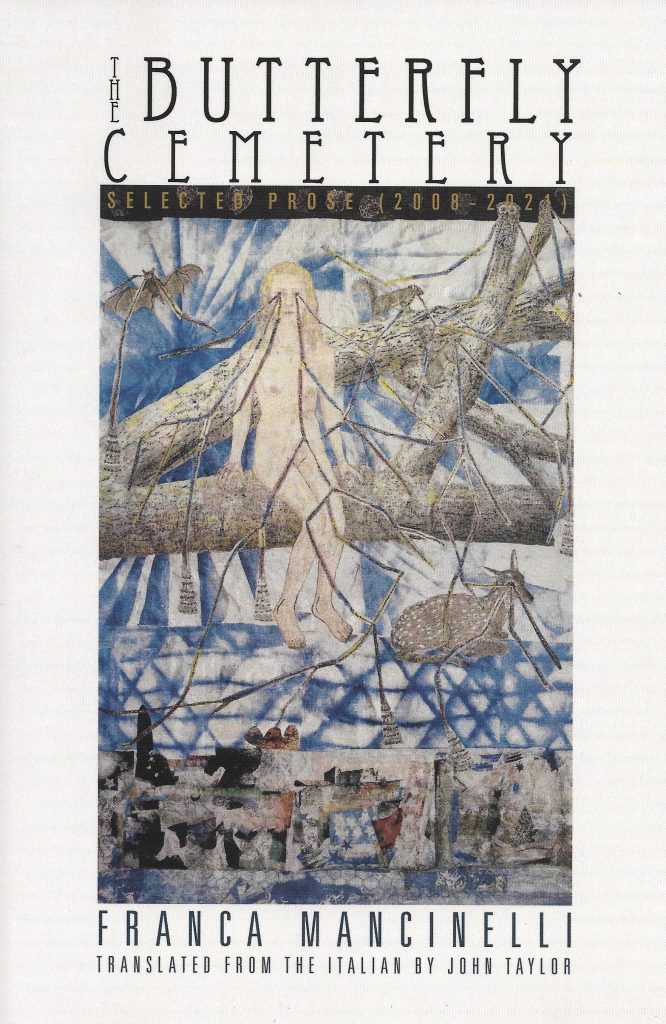
Details about the book: The Butterfly Cemetery: Selected Prose (2008-2021) – By : Franca Mancinelli, translated from the Italian by John Taylor / Published by: The Bitter Oleander Press / Year: 2022 / Pp. 182 / Price: $24.00. Website for The Bitter Oleander Press: https://www.bitteroleander.com
About the Author
Franca Mancinelli was born in Fano, Italy, in 1981. Widely considered to be one of the most significant Italian poets, she has been awarded several national prizes. Four of her books have appeared in English in John Taylor’s translations: The Little Book of Passage (2018), At an Hour’s Sleep from Here(2019), The Butterfly Cemetery (2022), and All the Eyes that I Have Opened (2024). Mancinelli has been selected for several important international programs, including the European poetry platform “Versopolis,” the Chair Poet in Residence (Calcutta, India), the European project “Refest: Images and Words on Refugee Routes,” and the “Ephemera” Writing Workshop in Bucharest. Her writing, which regularly appears in English-language poetry journals, is also featured in the University of Oxford project “Non solo muse: panorama della poesia italiana dal 1970 a oggi,” edited by Adele Bardazzi and Roberto Binetti, as well as in Europe in Poems: The Versopolis Anthology, edited by Patrick McGuinness (Arc Publications-Beletrina Academic Press, 2020).
About the Translator
John Taylor is an American writer, critic, and translator who lives in France. Among his many translations of Italian, Modern Greek, and French poetry are books by Philippe Jaccottet, Jacques Dupin, Pierre Chappuis, Pierre-Albert Jourdan, José-Flore Tappy, Charline Lambert, Béatrice Douvre, Pierre Voélin, Georges Perros, Elias Papadimitrakopoulos, Veroniki Dalakoura, Lorenzo Calogero, and Alfredo de Palchi. He is the author of several volumes of short prose and poetry, most recently Remembrance of Water & Twenty-Five Trees (The Bitter Oleander Press), A Notebook of Clouds & A Notebook of Ridges (The Fortnightly Review Press), which is a “double book” co-authored with the Swiss poet Pierre Chappuis, and What Comes from the Night (Coyote Arts Press).
About the Reviewer
Giorgia Meriggi is a poet and translator who regularly contributes to the Journal of Italian Translation. She has published two poetry collections with Marco Saya Edizioni, Riparare il Viola (Sottotraccia series, 2017) and La logica dei sommersi (2021). And for Biblion Editore, she has co-translated the Anglo-Caribbean poet Roger Robinson (A Portable Paradise, 2022). She is currently completing translations of Seamus Heaney (Stations) and Anne Carson (Men in the Off Hours).
Biographical references:
The first sentence alludes to the initial hymn of the Rigveda: “The poet who, offering in oblation all these worlds, has established himself as a priest offering gifts, he who is our father, seeking riches through prayer.” As translated from the Italian of Ṛgveda. Le strofe della sapienza, edited by S. Sami, Vencie: Marsilio Editori, 2000, p. 66.
Cristina Campo, Il parco dei cervi, Gli Imperdonabili, Milan: Adelphi, 1987 p. 144. The English version of the quotation has been made by John Taylor.
The radio dialogue between Franca Mancinelli and John Taylor took place on Trafika Europe Radio on 27 February 2022. The transcription as well as an expanded version of this conversation appeared as “A Beauty Not Yet Visible to Our Eyes: A Dialogue with Franca Mancinelli” in Eurolitkrant (April 2022).
John Taylor’s postface to The Butterfly Cemetery can also be read in Marina Emilie Macharis’s Italian translation: “Franca Mancinelli: l’invisibile a fronte,” formavera, 25 March 2025.
Giorgia Meriggi has carried out an in-depth interview with Franca Mancinelli and John Taylor about their work together. See “No Bridges at the Estuary: Giorgia Meriggi in Dialogue with Poet Franca Mancinelli and Translator John Taylor,” Reading in Translation, 17 November 2025: