The Tang Minister Fang Xuan-ling’s two-week leave had come to an end. He had spent the time in Chiangling, a guest of its obsequious governor. However, he was uninterested in the affairs of the city. Every afternoon he traveled three li from Chiangling to the modest two-room cottage of the retired sandal maker, peasant, poet, Chen Hsi-wei. Fang arrived shortly before noon each day in a carriage accompanied by two servants and with a small banquet from the governor’s kitchen. Minister Fang had long admired and collected Hsi-wei’s poems and had questions about their meanings and origins. He made notes of their conversations and each night recorded them in his journal.
On their last afternoon together, Fang asked Hsi-wei a different sort of question, not one about a particular poem. First, he acknowledged that Hsi-wei’s work was original, even, like his status as an educated peasant-poet, unique. Then he asked if there were any poets Hsi-wei admired and who might have inspired him. “I don’t mean the Shijing and Cao masters. We all revere the ancients. I mean poets of the last dynasty, excluding, of course, Emperor Yang. You’ve told me plainly what you think of Yangdi’s verses—and of him.”
“A writer as unsure of himself as I have always been often regards every other writer as superior to himself.”
Fang made a dismissive gesture with his hand. “That is your modesty speaking.”
Hsi-wei gave a little bow. “My lord, I have a great deal to be modest about.”
“Come now, Master Hsi-wei,” Fang insisted a little harshly. “You know very well how I value your work. By belittling it you also demean me.”
Hsi-wei looked alarmed. “That was certainly not my intention, my lord. I apologize. Your good opinion means so much to me. You make me think better of myself; but the moment I give in to basking in your praise I feel guilty. I’m like a scholar told he has passed the three-day examination but can hardly believe it because he knows how ignorant he is.”
Fang smiled at this analogy. “I was teasing you—at least in part. But tell me, is there a Sui poet you do admire, who perhaps even stirred you?”
Hsi-wei thought the question over before naming Xue Zunyan.
“Xue is someone I admire and not just for his formal old-style gushi verses, of which he is a modern master. I think Xue relished rules, discipline, good order. All his verses are strict, lines limited to five or seven characters. He even uses rhyme. Perhaps he loved the old forms with their strictures because he was a military man. Xue was a key officer in Sui’s victory over Chen. I esteem him as a man of imagination, craftiness, and also, I think, wisdom. Do you know of Xue Zunyan? His poems? What he did in the war? What he accomplished afterwards in Luoyang?”
Fang shook his head. “My knowledge of the early years of the last dynasty is as limited as my interest.”
“I understand. Yet I’m glad the Tang have not done what the Qin did when they burned all the books written before their time.”
“Well, like a hastening courier, I look forward not back.”
“So, the past is of little interest? You are a man of the future, my lord.”
“I would hope so.”
“Yet here you are taking precious time away from the court to spend with an old vagabond sandal maker who lived most of his life under the Sui.”
Fang refilled their teacups. “Your poems, Master Hsi-wei, are what drew me here, not the doings of Wendi and Yangdi.”
“So, you think my verses are unrelated to the times in which they were written?”
“Not at all. Of course not. What I think is that your poems will outlast those times, as you have yourself.”
Hsi-wei laughed. “So, my poems will outlast those times like Xue Zunyan’s of which you, a learned lover of poetry, haven’t heard?”
“Is that a reproof or more of your modesty?”
“Neither my lord. Or, well, perhaps just a little of both.”
“Can you recite any of this Xue’s poems? Perhaps you have a favorite?”
“I might be able to recall a few, but there is one I find particularly touching and revealing. In its time, it may even have been dangerous. It’s one in which he used rhymes, which makes it easier to remember.”
“I’d like to hear it.”
Hsi-wei took a moment to collect himself and recollect Xue’s verses. “The poem has a title, the name of a man. I think you’ll see why.”
Hsi-wei recited Xue’s poem simply but with mournful solemnity.
Sheltering from the summer sun
in the water garden of Shu
I sat alone and yearned for you,
slain just when the battle was won.
The troops embarked, the Yangtse crossed,
Victory gained but at high cost.
Our war was won yet you were lost.
“I think,” said Fang after pausing to pour out two more cups of tea, “Xue must have expressed what many felt, but I see why you’d call the poem dangerous. I doubt the victorious generals, the troops, and the emperor would care for it, especially not that final verse.”
Hsi-wei nodded. “I tried to find out all I could about Xue. His contributions to the Sui victory over Chen were critical, at least according to what an old veteran in Pengdeng told me.”
“How so?”
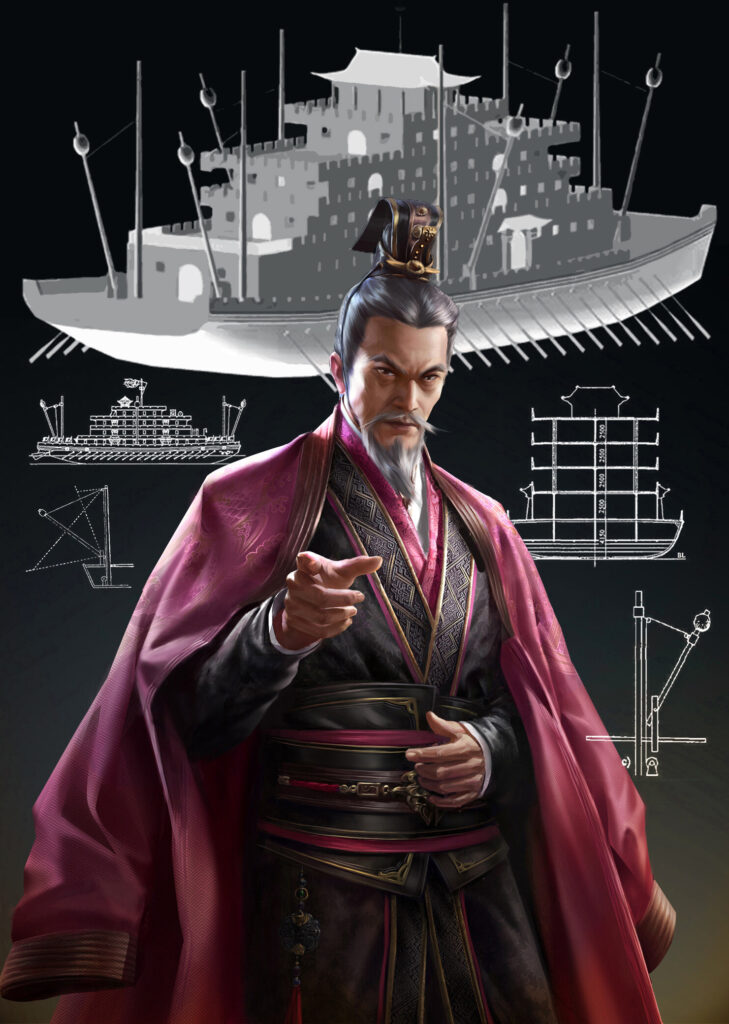
“The whole campaign hinged on getting his half a million men across the Yangtse, which was strongly defended by the Chen with forts at crucial points. In Wendi’s council, Xue made two suggestions. First, that a thousand transports be constructed, the five-banner ships, each able to carry eight hundred men. These ships were not to be merely passive vessels. They were to be fitted with spiked booms to make short work of Chen’s galleys. His second idea was supported by a group of experienced officers like himself. They opposed the strategy of attacking at a single point with concentrated forces, as custom dictated. Xue recommended dividing the forces and crossing at several points. One more thing. I believe Xue was also responsible for the thousands of flyers spread through the south before the attack.”
“I’ve heard of those. They declared that the corrupt Chen had forfeited the Mandate of Heaven. Is that so?”
“Yes, my lord. It seems Xue was the one who composed the text and a thousand scholars were put to work copying it. Spies were dispatched to spread these flyers and so demoralize both the population and Chen’s troops.”
“I should really know more of this campaign. How did it succeed so well?”
“Well, in addition to the five-banner ships, the five hundred thousand warriors, and the psychological undermining, Emperor Wen made three effective decisions. The first was to follow Xue’s and his colleagues’ advice. He ordered the troops to cross the river at five different spots, then form up into two bodies, a pincer that would march on Jiankang, the Chen capital, and encircle it. Wendi’s second decision was to coordinate the crossings precisely so enemy troops could not be moved to reinforce each other. The third decision was the day Wendi chose for the assault. It was that of the Yuanhui Festival when half the Chen army would have dispersed to their home villages and everyone would be celebrating the new year.”
“You are a good teacher, Hsi-wei,” Fang remarked. “You’ve put both a map and a calendar into my mind.”
“If you say so, my lord. Xue Zunyan was a gifted general. But I like that he deeply felt the sorrow of war. As you can imagine, Wendi’s court poets produced a flood of flattering paeans to his victory, but I can’t recall a single one of them.”
“What became of Xue Zunyan after the war?”
“Like other successful officers from noble northern families, Xue was given a high post in the new government. Wendi appointed him to his new Ministry of Rites.”
“You said you admired Xue as poet and a soldier but also for something else, something he accomplished after the war. What was that?”
“Well, there are two things actually. You’ll recall that Xue introduced rhymes into his verse, a rarity then as now. According to what I learned from Master Shen Kuo so many years ago, Xue Zunyan was one of the backers and a prolific contributor to the Qieyun.”
“That old dictionary of rhymes? I’ve seen a copy.”
“Yes, my lord. But of course it wasn’t old at the time. Xue Zunyan was a patriot. As a general, he contributed to the reunification of the empire by force of arms, but as a scholar he did the same linguistically. The Qieyun promoted peaceful unification between north and south by standardizing pronunciation.”
“I didn’t know that. But what else did Xue accomplish after the war? I think you mentioned a second exploit.”
“Yes, and what he did there was also in the cause of peace. It’s a good story and probably true, too. What Xue was said to have done in Luoyang just after the war impressed me. In fact, it inspired me to write a poem at the time.”
“Would I know the poem?”
“No. I never showed it to anyone. It’s poor work, juvenile. But I’ve kept it to remind myself of how ineptly I wrote back then. If you like, I’ll show it to you after I tell you how Xue resolved some post-war turmoil in the south.”
“Good. I’d like to hear the story, and I’ll look forward to reading your poem about which you are so typically modest. In fact, if you’ll permit, I’d like a copy to take away with me.”
“Very well. The year after the war ended the south was unsettled. Rivalries and enmities that had festered under the Chen broke out. Most were minor but a feud between two of the largest clans, the Ping and the Shi, turned violent. Here is what the strict poet, master tactician, and deputy minister of rites did about it. The Ping were spread over the province’s highlands. They raised livestock—water buffalo, pigs, ducks, sheep, chickens, geese. They disdained what they regarded as the indolent lives of the Shi, who occupied the lowlands, cultivating rice and every kind of vegetable. For their part, the Shi thought the Ping coarse, aggressive, and lazy. The animosity was of long-standing but had been kept in check before the war.”
“I suppose the focus of the feud was land?”
“Yes, exactly. The Shi were convinced that the Ping meant to take over large swathes of their cultivated lands for pasture. There were insults, brawls, skirmishes, then fighting. All trade between the farmers and the herders ended and open warfare seemed likely. When news of these disorders reached Daxing, the emperor called his advisors together. In those days, his council was made up entirely of veterans, his generals. Their almost unanimous recommendation was to send a large body of infantry troops into the province, arrest the chief instigators, and impose order by force. Xue Zunyan alone disagreed. He was a good poet and so had a good imagination. He argued that troops could do no more than suppress the conflict and that arrests would likely turn both clans against the regime. Moreover, an indefinite occupation would be expensive to sustain. He suggested that a better policy would resolve the dispute and pacify the province. He volunteered to go to Luoyang himself, if the emperor would grant him full powers and send a detachment of cavalry with him.
“Wendi did not want to send a large force to the south when his northern and western frontiers were under threat. He decided to do as Xue proposed. I was told he pointedly said to the grumbling council that perhaps a poet could accomplish what a regiment of infantry could not.
“Xue marched south with a hundred picked horsemen. He set up camp on the hilly land between the Ping and Shi. Then, in the name of the emperor, he summoned the leading men of both clans and, when they arrived, had his men put them all in shackles.
“With respect, Hsi-wei, that doesn’t sound notably poetic or imaginative,” observed Fang.
“Wait. Xue used force, it’s true, but only to keep the men from running off. It was force deployed to replace force, authority to forestall anarchy. He told the men of Ping and Shi that the emperor had given him authority over their region, and he intended to use it. He then ordered the men of Ping and Shi to exchange places for three months. They were to move, along with their families, the Ping down from the heights, the Shi up from their lowlands. The men of Ping would live in the homes of the men of Shi, the Shi in those of the Ping. Anyone who disobeyed his order would be hunted down by his horsemen, arrested, and sent north to face justice in Daxing.
When the three months were up, Xue had his cavalrymen bring to his camp the chief men of Shi and Ping. When they were gathered, he took his place on a platform and addressed them. He asked if they still had contempt for each other’s way of life, still thought their neighbors lazy and despicable. Did they now have a better grasp of what is required to be a good herder, a successful farmer. Did the Ping understand how they depended on the hard-working Shi for meat. Did the Shi know where they got their rice and what back-breaking labor it took to produce it. Did anybody think an efficient division of the land along with the promotion of lively trade likely to prove less profitable than brawling over the former and abstaining from the latter.”
“Clever of Xue. Did his plan succeed?”
“My lord,” said Hsi-wei with an impish grin, “would I be telling you the tale if it failed? Just as the Qieyun and the five-banner ships helped to put the empire back together, so Xue Zunyan’s relocation scheme brought peace to the clans in Luoyang, at least so I was told.”
“Well, true or not, it is a fine story with a happy outcome. I’ll bear in mind that, at least sometimes, a single poet can be a better peacemaker than five battalions of pikemen. As the proverb says, it is better to be wise than strong.”
“Well said, my lord, though I’d remind you that Xue marched into Luoyang with a hundred of the emperor’s best cavalry.”
“Point taken, Master Hsi-wei, and Emperor Gaozu understands quite well. In a council last year to decide our policy toward the Khitans, he said strength without intelligence is merely brutal and that intelligence without strength is simply helpless.”
Hsi-wei nodded approval. “I think Gaozu will prove a good emperor indeed.”
“I am fortunate to serve him. In fact, the sun is almost down and tomorrow I will go back to doing so. I will miss our afternoons. Who knows if we will meet again.”
“One shouldn’t ask too much of the future.”
“I depart at dawn, but my way takes me by here. With your permission, I will stop for a last farewell.
Hsi-wei got to his feet and bowed low. “I am, as always, honored by our good will, my lord, and by your friendship.”
Early the following morning, Fang Xuan-ling and his escort did stop briefly at Hsi-wei’s cottage. As they said their final goodbye, Hsi-wei handed Fang a small scroll, a copy of the youthful poem his guest had asked to take away with him.
The Tians had two sons, the elder
Liwei, Xinyu two years younger.
The boys were always at each other.
Liwei, bigger and stronger,
bullied his little brother.
Clever Xinyu knew how to exasperate
Liwei with mockery and sarcasm.
Mr. Tian chided the boys for upsetting
his wife and punished them with
spankings, chores, privations.
But, after a day or two, the boys
were back to fighting as usual.
Then Mrs. Tian had an idea.
She persuaded her husband to agree.
They brought the boys before them
as at a tribunal and declared
that instead of punishing them
they would play a game, a contest.
The boys liked the sound of that.
“What’s the game?” they asked eagerly,
both vowing that they would win.
“It’s a switching contest,” said Mrs. Tian.
“But first you must promise to play
for a whole week,” said Mr. Tian sternly,
“then we shall see who wins.”
The boys promised and Mrs. Tian explained.
“Yiwei, for seven days you will be the
younger and you, Xinyu, will be his
big brother. Whoever best imitates
the other will win the prize.”
At first, Xinyu used a stick to beat his brother
while Liwei taunted and ridiculed Xinyu.
So, Yiwei felt how it was to be bullied
and Xinyu what it was to be mercilessly teased.
By week’s end, the beating and mocking ended.
Mr. Tian awarded the victory to both, and
Mrs. Tian gave each two red bean paste buns.
To read more articles by the same author, click here
About the Author

Robert Wexelblatt is a professor of humanities at Boston University’s College of General Studies. He has published seventeen collections of short stories; two books of essays; two short novels; three books of poems; stories, essays, and poems in a variety of journals, and a novel awarded the Indie Book Awards first prize for fiction.