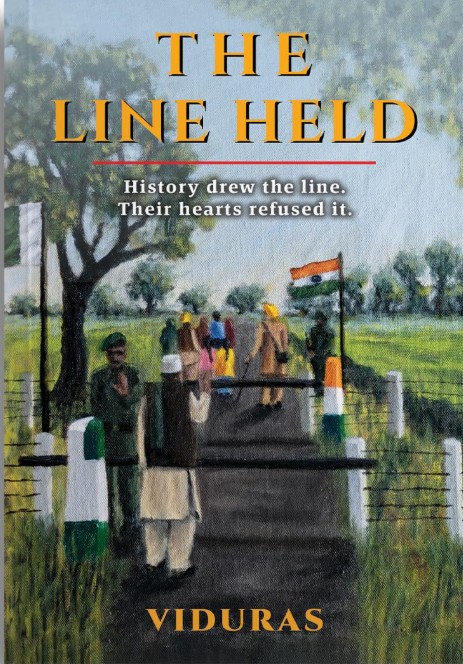
Satyamurthy Vembu is the author of the recently published novel The Line Held. He writes under the pen name Viduras.
Set in rural Punjab around Partition, The Line Held follows ordinary families whose lives and relationships are caught in the upheaval of 1947. At the heart of the story is the friendship between Kartar Singh and Haji Abdul Rahman Khan. Their lives are shaped by Partition, displacement and separation, but the friendship survives the political line that eventually divides them.
“The novel grew from stories I heard from grandmothers while growing up in rural Punjab. Those memories remained with me for nearly half a century before finding their way into the novel.” – Viduras
.***
What made you finally write The Line Held after carrying these memories for so many years?
I had heard these stories as children generally do; with a sense of awe and fascination. But I did not understand the pain behind them at that age. That world belonged to someone else. The people in those stories had lived through Partition, but to me they were simply stories from another time. I grew up, moved on, and carried those memories somewhere in the background of my mind. It was only much later that I began to understand what those stories really meant; that lives had been disrupted, that friendships had been tested, and that people had to endure mental, physical and monetary pain. Nearly half a century later, those memories began to return with a different meaning. That was when I felt the need to write The Line Held.
What was it about those childhood stories that stayed with you for so many years?
The story of Malerkotla and Thoha Khalsa remained etched in my mind. So did the struggle of the people as they tried to rebuild their lives after everything they had lost. Of course, the grandmothers did not tell us everything. I understand that now. They told us only what they thought children should hear and could understand. But as I grew older, I began to hear more, understand more and connect the dots. Things that had seemed like separate stories when I was a child gradually began to form a larger picture; the lives that had been disrupted, the homes that had been left behind, and the effort it took to rebuild ordinary lives. I think that understanding came much later. The stories remained, but their meaning changed as I grew older.
Why did you choose to tell the story through ordinary people rather than through the major historical figures of Partition?
I chose to tell the story through ordinary people because it is ordinary people who are affected by the decisions made by those in power. There is a line in the book that expresses this thought: “When a king makes a decision, many thousands of people may have to live with it.” Leaders make choices; people live with the consequences. Partition was a political decision, but its consequences were lived in homes, villages and families. People had to leave places they had known all their lives, rebuild their homes and livelihoods, and somehow carry on with their lives. That is the part of history I wanted to explore; not the decisions themselves, but the people who had to live with them.
The novel deals with Partition, a subject that has often been written about through the lens of religious conflict. What made you want to tell this story differently?
I agree that Partition was along religious lines, with politics and the struggle for power also playing their part. But those were the forces that caused Partition. The consequences were dealt with by ordinary people. Millions of people suffered because of it. And when people suffer, they naturally remember the bad people they encountered; those who hurt them, betrayed them or made their lives more difficult. But there were good people too. I have not tried to hide the violence in The Line Held. It was part of the reality of that time. But the real focus of the novel is on the other side of that reality; the goodness in people, friendship, compassion and the feeling of oneness that could exist across religious lines even when everything around them was pushing people apart. I wanted to remember that side of Partition too.
The title The Line Held is intriguing. What does the title mean to you?
The Line Held has more than one meaning for me. Most people did not choose the line, yet the line remained. And when we look at it today, it represents much more than a border on a map. It came to represent fear, hostility, religious division and war. It left behind widows and orphans, separated families and broken lives. That is the sad part. The people in the story did not create that line, but they had to live with it. And yet, even with the line there, some bonds between people held. That is what the title means to me.
The friendship between people of different faiths is central to the novel. Was that something you consciously set out to write about, or did it emerge naturally from the story?
Truth be told, I did not think about it in those terms when I began writing. It emerged as the story evolved. The friendship between people of different faiths was not something I planned or consciously set out to write about. It simply happened as the characters and their lives developed. Perhaps that is also how it was in real life. People lived together, knew one another, helped one another and shared their lives. Their religious identities were there, but they did not necessarily define their relationships. So I did not set out to make a statement about friendship across religious lines. It was not planned. It just happened.
How much of your own childhood and the Punjab you remember found its way into the novel?
A great deal of my childhood found its way into the novel, often without my consciously putting it there. The fields, the railway halt close to the house, the canal, the mango and sugarcane raids we went on as children. Then there were the sounds; the alarm calls of lapwings, the howl of a jackal at night, the bark of the village dogs, the rustle of the ripe wheat as we played next to them. There are just too many of these memories to list. I think those details stayed somewhere in me all these years. When I began writing, they simply came back. They helped me recreate not just a place, but the world I had known as a child.
Did writing The Line Held change the way you looked at those childhood memories?
I did visit the places where I grew up, but I have to be honest. The visits happened much after the story had already taken shape. Yet when I went back, some memories came flooding back. Places that I had not thought about for years suddenly brought back details I had forgotten. I brought some of those memories into the novel where they fitted naturally, to enrich the village life and make the setting feel more real. So the visits did not create the story, but they added texture to it.
Was there a particular character in The Line Held who became especially important to you as you wrote the story?
It was not one character but two; Haji and Kartar. Their friendship became the emotional centre of the story for me. They come from different religious backgrounds, but that is not what defines their relationship. They have known each other, lived alongside each other and shared the ordinary experiences of village life. As the story progresses and the world around them changes, their friendship is tested in ways neither of them could have imagined. In many ways, their relationship became the heart of The Line Held.
What did you want the reader to take away from the friendship between Haji and Kartar?
Friendship does not know religion, but religion knows how to break friendship. That, in many ways, is what I wanted the friendship between Haji and Kartar to convey. Their friendship exists naturally, without either of them thinking about the religious identity of the other. But circumstances can make those differences bigger than the people themselves. Ultimately, the choice is ours, what do we want to become bigger: the friendship or the divide?
After writing the novel, what do you think Partition left behind that history books cannot fully capture?
History can tell us when Partition happened, where the borders were drawn and how many people were displaced. But it cannot fully capture what it meant to an ordinary person to leave a home that had belonged to the family for generations. It cannot fully capture the fear of not knowing what lay ahead, the pain of leaving people behind, or the effort it took to rebuild a life from almost nothing. And perhaps most importantly, history can record the violence and the divisions, but it can sometimes overlook the goodness that existed alongside them; the people who helped one another, protected one another and remained friends despite the lines being drawn between them.
The numbers tell us how many people were affected. The stories tell us what it meant to be one of them.