By Franca Mancinelli, with remarks by the artist Pierre Delcourt
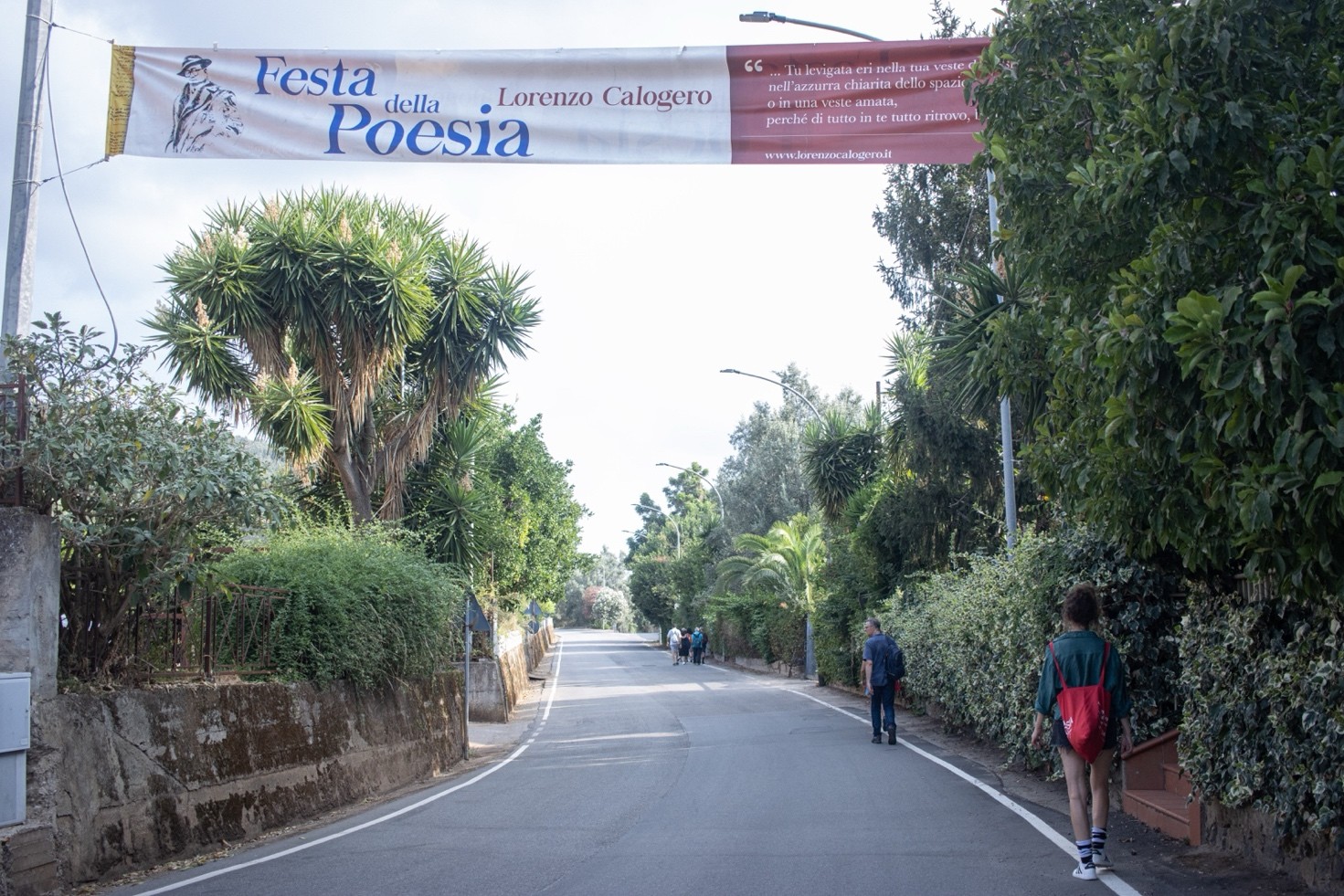
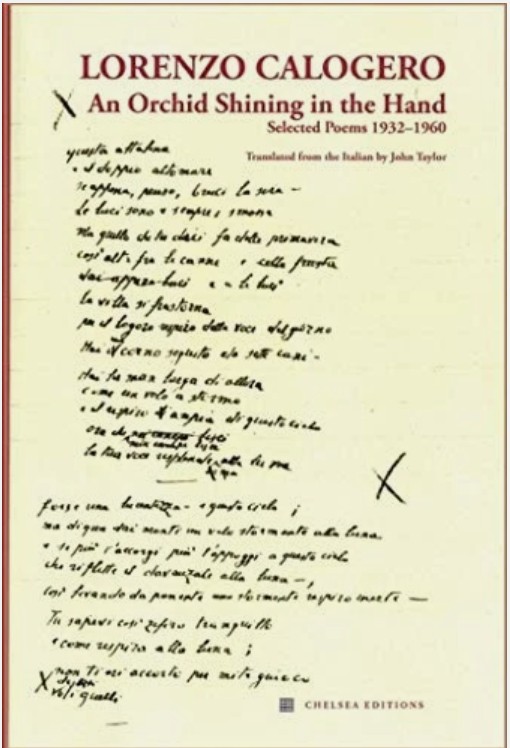
This dialogue stems from the Festa della Poesia, devoted to the poet Lorenzo Calogero (1910-1961), a poetry festival that has taken place for three years now in Calabria, in the village of Melicuccà. For the festival, the Edizioni LYRIKS published John Taylor’s chapbook, Mentre avanzi / As You Move Forward, accompanied by six of the French artist Pierre Delcourt’s ink drawings and including my afterword. For the occasion, Taylor also spoke of his translation of Calogero’s poetry, republished in 2024 by LYRIKS in a new expanded bilingual edition based on the initial Selected Poems issued by Chelsea Editions in 2015 with the title An Orchid Shining in the Hand. (This translation project won the Raiziss-de Palchi Fellowship from the Academy of American Poets in 2013.) Initiated by e-mail a few days before our stay in Melicuccà and continued during the festival, specifically during an itinerant writing workshop conducted by me, Taylor, and Sabine Ment through various sites associated with Calogero, this dialogue joins the flow of a near-daily literary exchange resulting from our working together for almost a decade, within the distance between two languages, and engaging in that process of metamorphosis in which we take part, like life as it continues, towards a meaning given moment by moment, in an open translation. The dialogue includes a few questions sent by e-mail to Pierre Delcourt. (F.M.)
***
Franca Mancinelli: After having devoted yourself especially to translation, literary criticism, and narrative or poetic prose, in this past decade you have turned to poetry, often working with artists. Among several artists, Caroline François-Rubino for Grassy Stairways (2017) and Remembrance of Water & Twenty-Five Trees (2018), and Sam Forder for What Comes from the Night (2024). For the Edizioni LYRIKS in Italy, two bilingual chapbooks have appeared, the first, Transizioni /Transitions (2021), with paintings by the Greek artist Alekos Fassianos, and now Mentre avanzi / As You Move Forward (2026) with ink drawings by the French artist Pierre Delcourt. What is the significance, for your poetry, of this dialogue with contemporary art?
John Taylor: My love for art began in childhood and, without really knowing why back then, I was already fascinated by art as a means of expressing perceptions and emotions. In contrast to words, which remain at one remove from reality, it can seem (from the writer’s viewpoint) that perceptions and emotions can be expressed more concretely in art through color, lines, figures, matter, and so on. Or at least expressed more immediately, from a much closer distance as it were. Ultimately, this is probably an illusion, but I nonetheless remain attentive to this potential possessed by art. I situate the dialogue at this level: finding the adequate means, or sharing the means with an artist-friend, to express in parallel certain perceptions, emotions and, not least, to raise certain questions. Much later, in the 1980s in Paris, when I was the translator of the Greek poet Elias Petropoulos, who also created bilingual livres d’artistes with his painter-friends, I had the privilege of meeting several Greek artists, including Alekos Fassianos, who provided paintings for Transizioni shortly before he died. When publishers in France, and then Nino Cannatà of LYRIKS in Italy, gave me the opportunity to work with my artist-friends, I could not be happier.
F.M.: How have you experienced the relationship between images and poetry in these projects?
J.T.: In all these projects, the basic idea is to create a dual work, or a parallel work, a work in which bridges between two sensibilities can be sensed. The images do not “illustrate” the poems, nor do the poems respond explicitly to the images. To prolong the bridge analogy, one can imagine two banks of a stream over which fords or footbridges exist from time to time. The very conception of such projects is based on friendship, on an openness to the work of the other. I sense in a friend’s artwork certain emotions or atmospheres evoked through his or her drawing or painting—that are in resonance with my writing. And the reciprocal is also true.
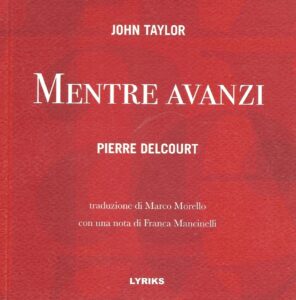
F.M.: How did you meet Pierre Delcourt and how did the project of As You Move Forward come about?
J.T.: Pierre and I met at the Galerie Akié Arichi in Paris, in autumn 2019. Pierre had a show of his paintings there at the time. Akié Arichi is a Franco-Japanese gallerist but also a publisher specialized in issuing bibliophilic books—livres d’artistes—bringing poems and images into dialogue. Akié had already published one such book of mine, Fragments for the Next Form, in French and English, which is a similar collaborative project with the French artist Jean-Marc Brunet. I was immediately drawn to Pierre’s paintings in the gallery and we quickly realized that we shared literary and artistic affinities. We discussed the possibility of working together on “something” that remained to be defined. A few months later, as we were corresponding and still thinking about this “something,” I wrote the sequence “As You Move Forward.” I took into account the fact that Pierre lived near the northern Brittany coast, had an intimate knowledge of the Atlantic (for he had worked as a fisherman), and that I had long wished to explore again an image that has always fascinated me: walking along the edge of a cliff, in this case one that is also found on the Brittany coast (but in a different area). Once I had written my sequence of poems, I received fairly quickly from Pierre his artistic responses. We corresponded by e-mail about the project, even when we could not meet in Paris for quite some time. I explained to him how much I sensed his deep understanding of my words. After a long wait, during which I continued to follow from afar his exhibitions, the project suddenly became possible. The first proofs of the book arrived unexpectedly from Akié in 2025, like a gift.
F.M.: Pierre, ever since 2006, you have published several livres d’artistes comprising texts by classic and contemporary poets, such as Matsuo Basho, Taneda Santoka, and Kenneth White. One of these books also includes three of your poems. What is your relationship to poetry and how do you explore the connection between word and image?
Pierre Delcourt: Painting renders moments that are at once reverie and presence; something ineffable takes form within the matter that emerges—a matter that I wish to be almost immaterial. In the words of poetry, I find something which I only vaguely recognize, yet which sustains me, guiding me toward those moments of presence and reverie—like an encounter, and like a shared solitude. I am delighted that this book has found a second life thanks to LYRIKS—and in Italy, no less, a country to which I feel very close and which I love dearly.
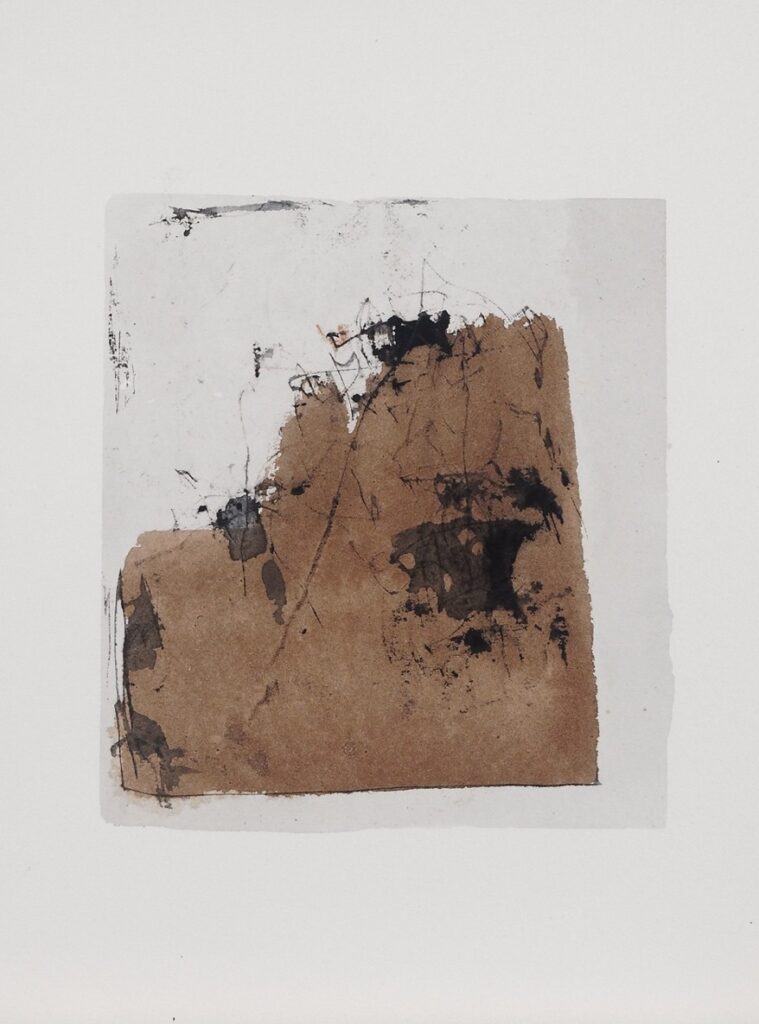
F.M.: Speaking of matter, which shapes the boundary between our perceptions and something we can only imagine, could you explain in some detail the technique you use to create those “almost immaterial” effects that so effectively express your vision of the world—and, more specifically, of the ocean and the Atlantic coast?
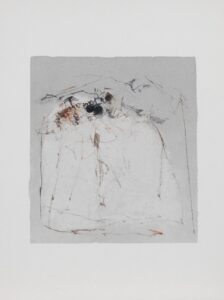
P.D.: I am always careful not to “paint” too much, in order to avoid losing the sensual, living quality of the canvas or paper, and to let the painting preserve its mystery. To accompany the poems in this book, I chose to use primarily pigmented inks; the simplicity of this medium seemed to best suit the spirit of the text. I sought to work within a restrained palette—earth tones, ochers, and ultramarine blue—while striving to let the texture maintain a vivid luminosity. It seemed to me that the slow vibration of those colored grays was best able to convey the intimacy of the text, its inner resonance, and its Atlantic metaphors.
F.M.: No formalism seems to be at play in your work, and the term “abstract” is problematic. What role does direct observation play? Or your close relationship with the Atlantic? What are the sources that nourish your painting?
P.D.: Painting, like poetry, remains an open question. If I were to pinpoint its source, I could only speak of an energy, an impulse—like an ephemeral response to a perpetually renewed question. On canvas or paper, this necessity takes shape as a succession of seemingly disparate attempts that eventually organize themselves, find their justification, and create a space possessing a distinct presence. Prior to this work is drawing, a privileged means of sensing the tangible world and managing to truly “see.” Ultimately, whatever the drawing—whether done directly from the subject matter or not—the work always leads me back to a singular, coherent space: a creative equivalent emerging from the realm of sensations and emotions which I have experienced and seek to render.
F.M.: John, in As You Move Forward, six of Pierre’s ink drawings open and close your sequence of poems, as if imagery were the starting point and the finishing point of poetry.
J.T.: In the original French-English edition published in Paris, each poem is placed in both languages on the lefthand page and is accompanied by a drawing on the righthand page, that is, with poem and image facing each other. The Italian edition offers a new way of sensing the connection between the poetry and the art. Like seagulls in haze over the ocean, the words emerge from Pierre’s vision and then vanish back into it.
F.M.: Now that your poems share the same space as Pierre’s images, has your relationship with his art changed from the time when you first saw it exhibited in Akié Arichi’s art gallery?
J.T.: Yes, it is like the difference between reading a book for pleasure and translating a book. Translation demands a deeper, more intimate kind of reading, of understanding. Even though, in this case, it was my poetry that provoked an artistic response from Pierre, I initially needed to assimilate his approach and sensibility by examining his paintings and looking at his albums and books made with other poets. I was fascinated by the nuances in his work, how shades of blue, brown, beige are modulated and flow in and out of each other. I felt a kinship with this art of subtle movement and indistinctness. As it turns out, it was Pierre who gave me the first copies of our French-English book in Akié Arichi’s gallery. Akié was not in the gallery that afternoon. When I opened the pages for the first time, I felt very moved, and so did Pierre, because we realized that we had actually created that “something” that we had sought to define so many years before. Pierre and I will continue to follow each other’s work, see each other when we can and—who knows?—perhaps create a new project.
F.M.: Pierre, what drew you to John’s poems, what resonances led you to the dialogue from which As You Move Forward emerged?
P.D.: With few words and a remarkably simple style, John’s sequence speaks with great sensitivity and intimacy about our life’s journey. How else can I put it? I felt as if a friend were writing to me personally. It moved me deeply, and I immediately wanted to use painting to try to express the emotions that it stirred within me.
F.M.: John, the theme of walking through the landscape, as a form of writing with one’s own body, is a central one in this chapbook, including the title—but in your work also recur mountain trails and paths along the Loire and the Atlantic Coast. How do you experience this connection between the rhythm of taking steps and writing poetry?
J.T.: Like you, Franca, it is usually not in my study that I begin to write a poem, but rather outside, while I am walking, gardening or even shopping for groceries. By the way, when I was studying mathematics at the university, it was also often outside my student room that solutions to difficult mathematical problems came to me, as if delivered to me by some invisible angel. It is a mysterious phenomenon which can probably not entirely be explained, but which surely has to do with a kind of openness or higher degree of attentiveness that is attained by the mind, by the five senses—one could almost risk saying “by the soul”—when we are in movement and put thoughts and worries to the side for a while. We somehow enter into harmony with—or become especially conscious of—the movements of the cosmos. It is a kind of dialogue—or a “flowing”—between inner and outer worlds, between subjectivity and objectivity, between sub-consciousness and consciousness. It is a dialogue consisting of whispers, of murmurs, of a few overheard words, which the poet must attempt to record.
F.M.: Fragmentary forms often appear in your collections. Can they be connected to the experience of walking?
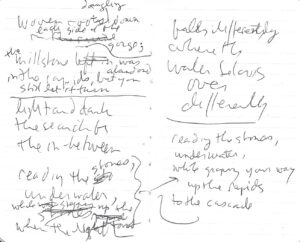
J.T.: Yes, this is possible, at least in my case and in yours as well. When we walk outdoors, in the “openness,” in the “aperto” (as the wonderful Italian word puts it), we see something, or sense something, or a few words unexpectedly come to mind. These experiences or “encounters,” which cannot be scheduled in any way, leave not entirely visible traces, just a few traces, in this openness through which we are walking. We jot down the few words in our notebooks to remember them, to commemorate or honor this “encounter.” The words themselves, at least in my case, usually form a fragment—nothing “closed” like a declarative sentence or an aphorism. A fundamental incompleteness is at stake, an “open-endedness,” and it seems to relate deeply to our human condition. Later, when I rework these words, having typed them into my computer, the challenge is to deepen further what I have seen, or felt, or thought, all the while preserving the mystery of this encounter, which is fragmentary and unfinished by its very nature.
F.M.: In this process of becoming aware that unfolds through writing—as you “move forward” along the path—what is the role of the landscape in which you are enveloped?
J.T.: For reasons perhaps having to do with a serious childhood illness from which I recovered after a long convalescence, I sensed early on in my life a kind of separation not only from my playmates, but also from nature. The landscape—even an oak tree in our backyard or a stream along which I would walk—was a kind of backdrop to which I did not belong and, in an intimate sense, could not really reach. In my writing, I try to move forward towards this landscape, whatever it is, to “bridge the gap.” By the way, I think that there are lines and images in Lorenzo Calogero’s poetry that suggest the same kind of separation. His notion of a “diptych” applies not only to the split self, but also to various kinds of “separations” that he experienced deeply.
F.M.: Your reference to Calogero is striking. In this state of separation—from which, for various reasons, one manages to perceive reality—the power of the imagination moves forward to take the place of feet, bridging the void and opening up a vision that would otherwise be inaccessible. I think of you as a sick child at your room’s window, and of Lorenzo Calogero at the windowpanes of the Villa Nuccia Nursing Home. Writing is also a space of redemption and restitution, the place where the dreamt-of landscape—crossed by the mind—emerges.
J.T.: My first two books of short prose texts mostly conjure up my childhood in Des Moines, far from the ocean and far from the mountains. But my subsequent books of prose or poetry have often been stimulated by what I knew very little, if at all, back then as a child. I was fourteen years old when I saw the ocean for the first time. When I was a child, I knew the mountains a little because in the summer my parents would take me and my sisters to visit our grandparents, who lived in Idaho, in the foothills of the Rocky Mountains. But we would never hike in those mountains, so the high slopes, not to mention peaks and glaciers, could only be glimpsed from afar or simply imagined from the tales or writings of others. It seems that what I could not reach in childhood, what I could not know intimately through concrete experiences, initially created the tension, the desire, and the curiosity which are necessary to writing. Having now lived in Europe for more than fifty years, I have often stayed at the sea, especially the Atlantic but also the Mediterranean when I was living in Samos (1976-1977), and I have spent even longer sojourns hiking in the Alps. But much of that initial mystery, surrounding the sea and the mountains, remains deeply within me, even when I am walking along paths whose every bend and rise I now know by heart. It is thus not really a question of acquiring knowledge or experience. To give one example: I am interested in botany and have learned to identify wildflowers during my hikes in the mountains. But the mystery of flowers remains vibrant and unfathomable in its splendor—and it is this that beckons to me, sometimes sparking the first few words of a poem. For me, writing can therefore be understood as a “moving towards” what remains other. In a sense, this new book, As You Move Forward, traces this process of “progressing,” this time along a cliff that overlooks what is unknown, the ocean but also in a metaphorical sense. For the same reason, walking and writing can be a “moving forward” to an origin, to a source.
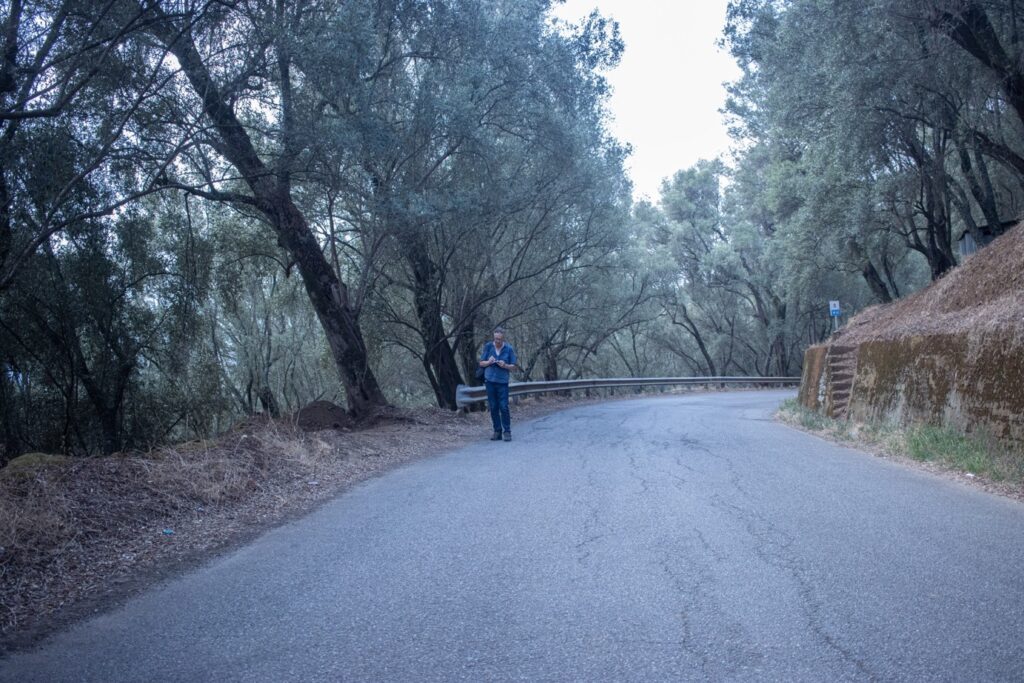
F.M.: The high cliff on the Atlantic coast that is evoked in As You Move Forward could also recall, in a sense, a few places along the Violet Coast which were dear to Calogero and which we also have now seen while walking together along the narrow “azure” trail—also called “tracciolino,” the “tiny trace”—between Palmi and Bagnara, with Sabine Ment as our guide, on the last day of our itinerant writing workshop. Do you recognize similarities between the two seascapes?
J.T.: The Mediterranean can have an exuberant quality, indeed especially visible in the dramatic landscape of the Violet Coast, with sharp contrasts in colors, whereas the Atlantic, at the precise spot where these poems are set, often consists of nuances of gray, beige, and brown, in the cliffs, the rocks, the sand, the seaweed, and the water. But in these poems, I essentially situate myself on any cliff, at any edge of any sea or ocean. Similar images have occurred in other texts, notably the poems set in Sète (France) in Transizioni. A walk along a cliff—a limit—that is also perhaps a threshold. A threshold leading to something else, to an “elsewhere,” to another state of being—or so we imagine, then doubt, then imagine once again. We move forward, perhaps a little too far, then step back, then. . .
F.M.: After a few trips and long stays elsewhere in Europe, you settled in Angers, with your wife, and you have lived there for almost forty years. The town is only about two or three hours by train or car from the Atlantic coast. What beckons you to such places overlooking the sea? What affinities do the places have with your writing and your way of perceiving things?
J.T.: If I think of the seas and oceans that I have seen, sometimes only briefly, I would say that what attracts me to them is the vast expanse of water (as an—ultimately deceiving—metaphor of infinity), the to-and-fro of the waves, and, as I have already suggested, especially all the edges between land and water: the cliffs and dunes but also the relatively flat beaches where I can watch what the sea washes up on the sand or among the pebbles and what the waves take back into the depths. I have indeed lived in Angers, in Western France, since 1987. It is the Atlantic coast that I have come to know more intimately, especially the long stretch running from La Rochelle to the beginning of Brittany more or less in the Guérande salt beds and from there along the southern Brittany coast to the distant western tip of Douarnenez, a town associated with a writer whom I have translated, Georges Perros. Until a few years ago, I had always visited the many ancient Celtic sites in Brittany out of curiosity, without drawing from them any specific inspiration for my writing. But I have recently become more attentive to these places and my book What Comes from the Night includes one short sequence of poems taking off from burial rites on a small island visible from a cliff on the Quiberon Peninsula and another sequence is inspired by three tombstones on a wall in a medieval abbey. It is very probable, Franca, that some of your own sequences, such as “To the Tiny Bronze Offering Bearers Found on Mount Titano” (from your most recent book, All the Eyes that I Have Opened) opened my eyes in a way enabling me to observe these vestiges differently, more deeply.
F.M.: You were the first person to translate such a large selection of Lorenzo Calogero’s poetry into a foreign language. I am referring to the big bilingual anthology published in the United States in 2015, and recently republished in a still larger edition by LYRIKS. Has translating Calogero’s poetry nourished or affected your own writing as a poet and narrator?
J.T.: This is a question about which I sometimes wonder. I first discovered and then translated Calogero’s poems in the years 2012-2015. For several years before this period, I had written relatively little. At the time, I was very active as a literary critic and writing essays about European and especially French poets and writers. I was also extensively translating two French-language poets who would leave their mark on me, notably in terms of their approach to landscape, to their questioning of a human being’s relationship to the natural world: Philippe Jaccottet and Pierre-Albert Jourdan. This is when Calogero came along, by chance, like a “mysterious stranger” (to recall the title of Mark Twain’s novella). Several years later after finishing my translation of Calogero’s poetry, while rereading his poetry in order to write a critical article, I realized that one thing—among several others—that had left its mark on me was his search for “lievità,” literally “lightness.” The word or its synonyms appears rather often in his work. To state the matter simply, let me quote his line “La lievità commosse le cose” (“Lightness moved things”). It is found in As in Diptychs. The line still spellbinds me. Calogero seems to receive the very vibration of the last line of Paradise (and The Divine Comedy)—“The love that moves the sun and the other stars”—and offer a variant more appropriate to his experience, to his sensibility. A more sober or austere variant in which love becomes lightness and the sun and the stars become “things,” any “thing,” a more abstract term whose metaphorical extensions in everyday language can indicate more than strictly material things, such as the events and phenomena that we experience. In his mind, this mysterious “lightness” has the ability to move things, to give emotion to them. It made me think of what, in the Middle Ages, was called the primum mobile. Could Being thus resemble or possess a form of “lightness”? Or the cosmos? Human life? I don’t know the answer, but the line encourages me to keep asking.
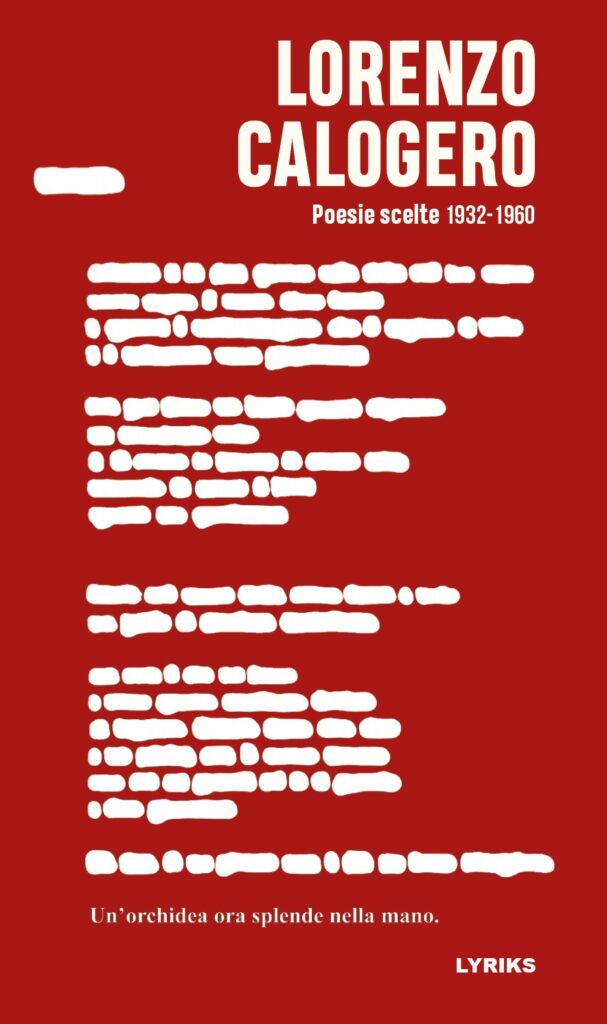
F.M.: An Orchid Shining in the Hand—the beautiful title that you gave to the anthology—strikingly encapsulates Lorenzo Calogero’s poetics. This line, which concludes a poem (XXVII) from his Villa Nuccia Notebooks, embodies the capacity of exposing oneself to darkness, of moving toward its dazzling essence and its charge of vitality. The orchid which Calogero has in mind is, I think, a black one, like the one mentioned in an earlier poem (XXI), where the flower heralds the appearance of a female presence—“you and your dark swollen hair.” Yet regardless of the color, this image brings to life that splendor—described in another text as “superhuman”—capable of transforming pain into light and making the darkness radiant. Two years later, your poetry collection The Dark Brightness was issued, followed the next year by the Italian translation published by Mimesis: L’oscuro splendore (2018). We were able to discuss the book together at a reading in Bologna. It was only a few years later, after deepening my understanding of Calogero’s poetry thanks to you, and participating in the presentation of the expanded reissue of that anthology by LYRIKS during the first Festa della Poesia in Melicuccà, that I realized how deeply resonant those two titles were with one another.
J.T.: What you are bringing together here moves me, especially when you point out that pain can be turned into light. It is a theme—a possibility—also very present in your own writing. With our writing, we try to approach and explore this potentiality. There is indeed a symbolic connection between the title that I chose for my translations of Calogero’s poetry and the title that I gave to my poetry collection published in 2017, just two years afterwards. At the time, the image of a “dark brightness” was not a conscious allusion to Calogero’s poem, but it does represent still another example of a phenomenon in which opposites are perceived as co-existing or moving into and out of each other. The sequence from which this title comes, “But it was not yet night,” presents this interconnection from various angles, such as in this poem, which I can cite while thinking of your own sequence, “Master Trees” (in All the Eyes that I Have Opened). I write:
sometimes trees persist
closer to you
than you had thought
they emerge
even the darkest
bear light
a sudden dark reassurance
I don’t see “dark brightness” as an oxymoron, but rather a valid potentiality. In fact, images in which light and darkness converge crop up rather often in my writing; or, alternatively, images, in a sense, “halfway” between opposites, in a liminary space, like the fog or mist in As You Move Forward.
F.M.: Rereading Calogero in the anthology published by LYRIKS, I realize that poems initially opaque or inert for me on the page can suddenly vibrate, come to life, and sweep me into a dimension where I seem to witness the very movement of reality from within. It is obvious that they were simply waiting for a different state of attention, a different intensity of presence, to come alive. Has something similar happened to you in your experience as a reader and translator?
J.T.: Translation can be hard work, and Calogero’s poetry offers an excellent example of this. The translator has his nose to the grindstone, as it were, and his marvel at what he is attempting to render might well come later. Such was the case with me. I have already mentioned my admiration for the poet’s use of the word “lievità.” Another poem, one of his earliest, dating back to 1936, keeps coming back to me. It is called “Structure of my Poems.” Let me quote several lines from the beginning:
Fragments of life
thrown by chance
onto watery waves
among stone-strewn lands—
these are my poems,
while something holding me by the hand
urges me to see
glorious mountains covered with houses
and human beings,
houses and marvelous substances,
steep precipitous lands
over which ride muleteers
choosing among a thousand paths
a single one for themselves,
then flying off at will
before night falls suddenly,
mellifluously. [. . .]
Several years after translating this poem, whose Italian transcription is now provided in a longer and more accurate version in the new edition published by LYRIKS, I realized that these lines had long fascinated me because they recalled the first poem that I loved by Hölderlin, “Hyperions Schicksalslied,” “Hyperion’s Song of Fate.” The last strophe reads, in my English translation:
But it is given to us
to have no rest anywhere.
Vanishing, falling,
we suffering humans
go blindly from one
hour to the next
like water from cliff
to cliff, thrown
downward for years into Uncertainty.
In Calogero’s poem, which can almost be read as an echo of Hölderlin’s poem, note the last two lines quoted above: “. . .before night falls suddenly, / mellifluously.” The word “mellifluously” bears witness to the inherent positive qualities of the night.
F.M.: Are there other poems by Calogero that stay with you, unforgettably, and that you find yourself revisiting in your mind as they unfold in their radiant obscurity?
J.T.: “Little Sound,” one of Calogero’s best-known poems, often comes to mind for reasons similar to this search for a little light in the darkness, indeed for the splendor that is inherent to darkness. The poet first evokes a “rovinoso mare,” which I translate as a “catastrophic sea,” but then he hears, from within the din and roar, a “little sound” seemingly from Eternity:
From such a catastrophic sea
a little sound arrives
at my ear listening closely
to Eternity
passing by like an angel.
Although I doubt that Calogero read Japanese poetry, the theme of his poem—the very potentiality that the lines puts forth—can be placed in parallel with a haiku, by Issa, on which you focus in one of your recent essays, “Flowers and Hell: On Poetry and Authenticity,” and to which I respond with my text “A Perennial Hereness.” Here is Issa’s poem, in my own English rendering, which I have based on the Italian version given to us by Massimo Raveri:
In this world
there are flowers that we admire
and there is hell.
F.M.: When I discussed the available versions of Issa’s haiku with him, he pointed out that they betrayed the poet’s perspective by placing hell somewhere other than where the flowers are—in an underground realm or a dimension otherwise separate from everyday reality—whereas Issa intends to show us that hell lies right here, in the ordinariness of this world, alongside the splendor of the flowers. Translators had imposed a Western lens that tends to separate beauty from darkness and the abyss. Translation often engages a vision.
Speaking of vision: in your poems, it is never something sharp or fixed once and for all; rather, it often takes shape through a dynamic interplay with the inability to distinguish or focus—with the act of fading away. I am especially thinking of As You Move Forward, but also of Portholes and other texts of yours where fog, mist, haze—or simply a veil or a distance—plays a central role, creating a space where something appears only to vanish again.
J.T.: You have grasped one of the fundamental aspects of my poetics, indeed of my way of looking at the world. For me, as far back as I can remember, everything seems in movement: the sea of course, as in As You Move Forward, but also the mountains in some of my other recent books. Flowers stirring in a breeze, but also rocks on a windless plateau. Moreover, Franca, this vision is not far removed from your own way of perceiving reality, as being in a constant state of metamorphosis. When I was discovering ancient Greek literature, on my own, during my high school years, and first came across the insight attributed to Heraclitus, “everything flows” (panta rhei), I realized that these two words summarized what I had so often sensed without being able to formulate it. In a more general sense, as I write, whatever the subject matter, I am drawn to borders, limits, edges, in-between states, and what remains undefined. It is when we find ourselves in such situations, when we fully sense the “threshold”, that we also simultaneously feel what it means to be alive.
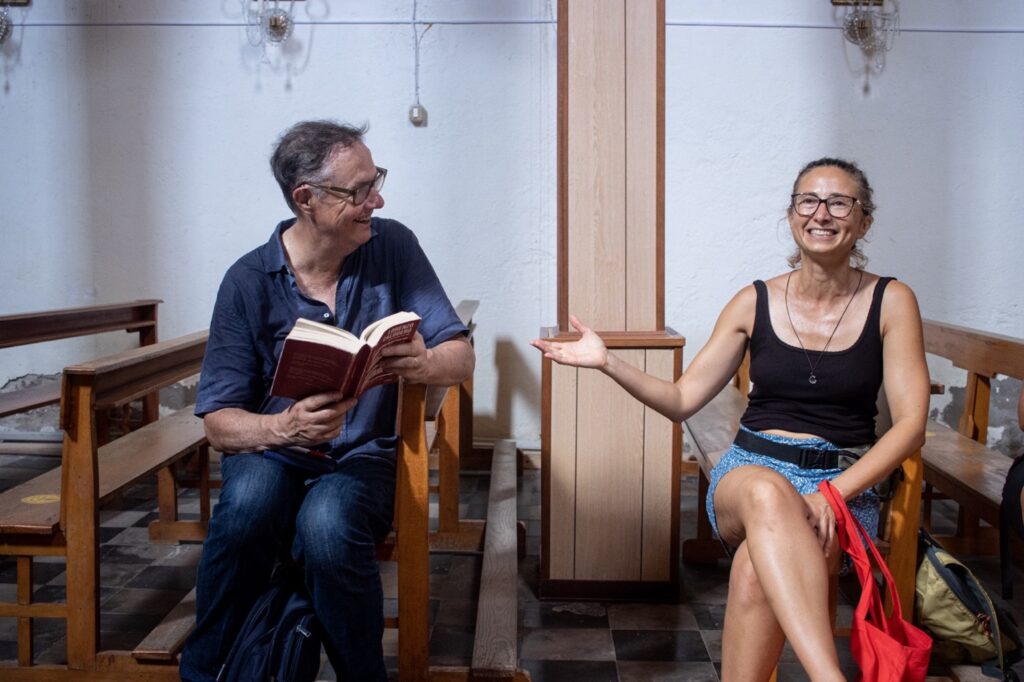
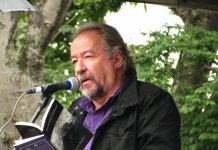
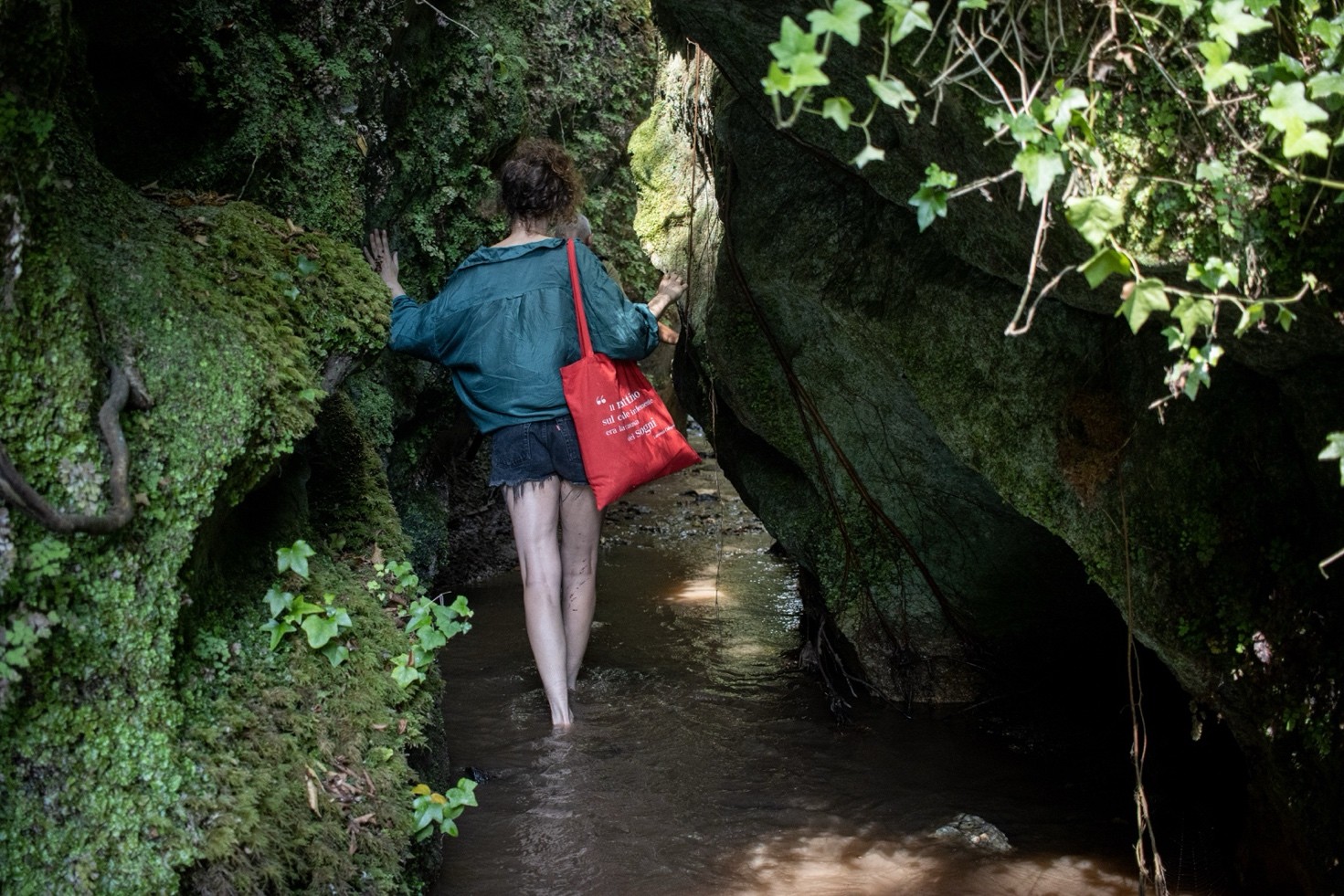
Photos by ©Salvatore Insana, taken during the Festa della Poesia—Lorenzo Calogero, 2026, especially during the writing workshop devoted to sites dear to Calogero and conducted by me, John Taylor, and Sabine Ment.
Notes
Franca Mancinelli’s original Italian essay about Issa’s haiku, “I Fiori e l’inferno,” is found in Un altro vero: Poesia e autenticità come dialogo e ricerca, edited by Maria Borio and Laura Di Corcia, Mimesis Edizioni, 2026, pp. 101-106. In English, this same essay, “Flowers and Hell: On Poetry and Authenticity,” in John Taylor’s translation and with Taylor’s own essay (“A Perennial Hereness”) as a response, was published as “What Brings Us to a Halt” on the website Hopscotch Translation, 27 May and 10 June 2025.
Books Cited:
Lorenzo Calogero:
Un’orchidea ora splende nella mano / An Orchid Shining in the Hand: Poesie scelte / Selected Poems 1932-1960, English translation by John Taylor, LYRIKS, 2024.
An Orchid Shining in the Hand: Selected Poems 1932-1960, English translation by John Taylor, Chelsea Editions, 2015.
John Taylor:
Mentre avanzi / As You Move Forward, Italian translation by Marco Morello, with an afterword by Franca Mancinelli, LYRIKS, 2026.
What Comes from the Night, Coyote Arts Press, 2024.
Transizioni / Transitions, Italian translation by Marco Morello, with afterwords by Franca Mancinelli and Tommaso Di Dio, LYRIKS, 2021.
Fragments for the Next Form / Fragments pour la prochaine forme, French translation by Françoise Daviet-Taylor, Éditions Arichi, 2019.
Remembrance of Water & Twenty-Five Trees, The Bitter Oleander Press, 2018.
“Portholes” in Grassy Stairways, The MadHat Press, 2017. In Italian: Oblò / Portholes, translation by Marco Morello, with an afterword by Franca Mancinelli, Edizioni Pietre Vive, 2019.
The Dark Brightness, Xenos Books, 2017. In Italian: L’oscuro splendore / The Dark Brightness, translation by Marco Morello, Mimesis Edizioni, 2018.
Franca Mancinelli:
All the Eyes that I Have Opened, Black Square Editions, 2023. In Italian: Tutti gli occhi che ho aperto, Marcos y Marcos, 2020.
Other Books by Mancinelli in John Taylor’s English translations:
The Butterfly Cemetery: Selected Prose 2008-2021, The Bitter Oleander Press, 2022.
At an Hour’s Sleep from Here, The Bitter Oleander Press, 2019.
The Little Book of Passage, The Bitter Oleander Press, 2018.
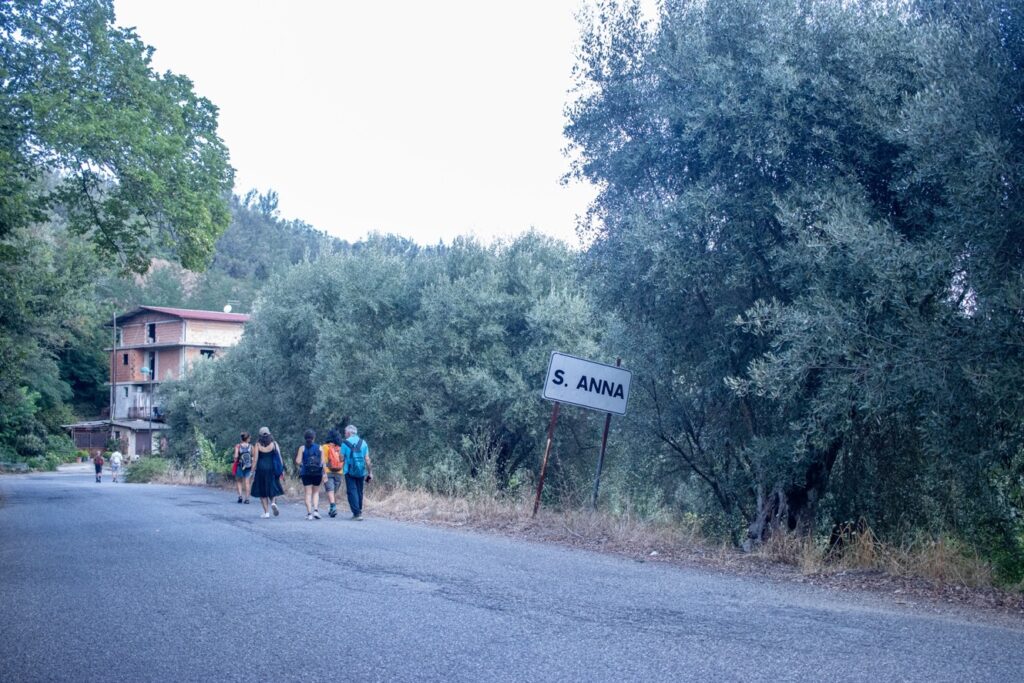
John Taylor and Franca Mancinelli, San Luigi Church, Sant’Anna (Seminara)
About the Interviewer
Franca Mancinelli was born in Fano, Italy, in 1981. Widely considered to be one of the most significant Italian poets, she has been awarded several national prizes. As noted in the above bibliography, four of her books have appeared in English in John Taylor’s translations. Mancinelli has been selected for several important international programs, including the European poetry platform “Versopolis,” the Chair Poet in Residence (Calcutta, India), the European project “Refest: Images and Words on Refugee Routes,” and the “Ephemera” Writing Workshop in Bucharest. Her writing, which regularly appears in English-language poetry journals, is also featured in the University of Oxford project “Non solo muse: panorama della poesia italiana dal 1970 a oggi,” edited by Adele Bardazzi and Roberto Binetti, as well as in Europe in Poems: The Versopolis Anthology, edited by Patrick McGuinness (Arc Publications-Beletrina Academic Press, 2020).
About the Artist
Pierre Delcourt is a French artist who lives and works in Brittany and Paris. His art is exhibited widely in France and abroad (Tokyo, Vienna, New York). He draws his inspiration from nature and the light of Brittany as well as from dialogues with poets. As mentioned in the interview, Delcourt has realized livres d’artiste with many poets, both contemporary and classical, French and foreign. At once abstract and intimist, his painting is elaborated in an intuitive manner and employs a range of restrained yet vibrant tones. Effacements, élans, and renunciations little by little build a singular, sensitive space in which each spectator can recognize a part of oneself.
About the Author
John Taylor is an American writer, critic, and translator who has lived in France since 1977. Besides the books mentioned in the interview and the bibliography, his recent translations of French, Modern Greek, and Italian literature include books by Philippe Jaccottet, Pascal Quignard, Jacques Dupin, Pierre Chappuis, Pierre-Albert Jourdan, José-Flore Tappy, Charline Lambert, Béatrice Douvre, Pierre Voélin, Georges Perros, Elias Papadimitrakopoulos, Elias Petropoulos, Veroniki Dalakoura, and Alfredo de Palchi.